
Sand blasting (unified matte texture)
It is used to unify the surface feel and look and feel, and reduce the difference in local powdery feel; suitable for the "long-lasting" appearance requirements of industrial parts and assemblies.
Nylon PA12-Dyed Black belongs to the SLS nylon system, leaning more toward a "functional" choice: balanced strength and toughness, abrasion and fatigue resistance, and no support required, suitable for complex structures and batch typesetting production.
Quote checklist: Upload your 3D model and, when available, a 2D drawing. Identify the required process, material, quantity, critical dimensions, finish, appearance standard, and target delivery date.
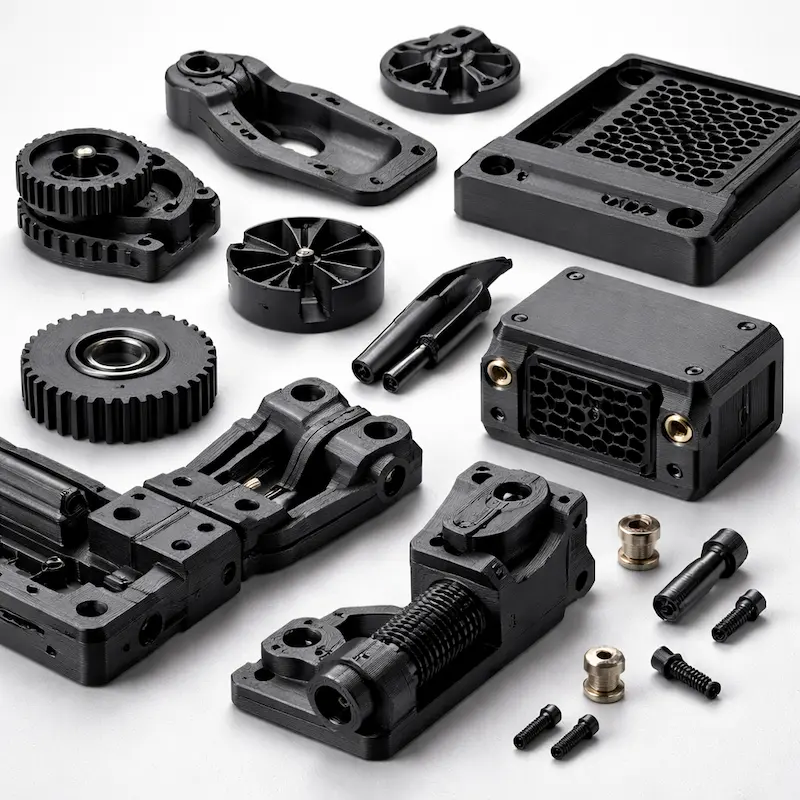
Engineering note: Values below are typical reference ranges. Final manufacturability, tolerances, material condition, surface finish, cost, and lead time depend on the drawing, geometry, quantity, and selected process.
Upload CAD files and mark critical features for an engineering review before production.
| Process | SLS selective laser sintering (nylon powder) |
|---|---|
| Color | Black (industrial parts are more resistant to dirt; optional spray paint if higher consistency is required) |
| Layer thickness | ~0.10–0.12 mm (device/strategy dependent; higher accuracy needs to be evaluated) |
| Dimensional tolerance | Common ±0.20 mm or ±0.20% (whichever is greater); it is recommended to mark tolerances and benchmarks on mating parts, and reserve assembly allowance |
| Minimum wall thickness | ≥0.8 mm (commonly used lower limit); structural parts recommended ≥1.2–1.5 mm; stress/screw vicinity recommended ≥2.0 mm |
| Minimum aperture | It is recommended that the forming hole be ≥1.5–2.0 mm; it is recommended that the deep hole/long hole be larger and consider cleaning the powder; it is recommended that the mating hole be left with a margin before finishing. |
| Powder cleaning and powder discharge holes | It is recommended to set powder vents for closed cavities; narrow and long inner cavities/internal channels need to assess cleanability (this will affect quote and delivery). |
| Tensile strength | 45–55 MPa |
| Service temperature | About 120℃ (short-time/working conditions need to be evaluated in combination with structure and load) |
| Density | About 1.02 g/cm³ |
| Surface look and feel | Fine matte, slightly sandy (sandblasting can unify the texture; painting can improve the appearance and consistency of the finished product) |
| Recommended maximum unit size | It is related to the equipment molding space and typesetting; oversized parts can be split and spliced or MJF/CNC and other solutions can be evaluated |
| Suitable for batches | Supports the typesetting of multiple pieces in the same cylinder, suitable for low- to medium-volume production and repeated parts delivery |
| Assembly enhancements | support Threaded inserts; Please indicate the thread specification (such as M2/M3/M4), quantity and location; please note if you need to enlarge/ream/tapping |
| Finishing | Sandblasting, threaded inserts, and painting |
| Typical lead time | Related to size, quantity, typesetting and finishing; clear delivery and expedited options will be given after uploading the file |
It is used to unify the surface feel and look and feel, and reduce the difference in local powdery feel; suitable for the "long-lasting" appearance requirements of industrial parts and assemblies.
Used for screw connection and repeated disassembly and assembly to improve thread strength and durability. Please note the thread specification, quantity and location; cooperate with reaming/finishing if necessary.
When you need to get closer to the color consistency of the finished product, cover a fine powdery feel, or achieve a specific surface effect (matte/semi-matte/high-gloss), it is recommended to choose spray paint and provide a reference picture or appearance standard.
Compared to standard SLA resin, nylon is more suitable for structural validation, wear-resistant moving parts and functional parts that require a certain degree of fatigue resistance.
No support required, suitable for production of complex shapes, inner cavities, grids and multi-piece layouts; reducing support marks and processing hours.
Producing multiple pieces in the same mold is more conducive to delivery consistency and cost optimization; suitable for repeated parts, spare parts, and small batch trial production.
The black appearance is more durable and durable in actual use and assembly environments; it can be combined if higher consistency is required. spray paint Achieve color difference control.
| Material | Key Advantages | Mainly applicable | Not suitable |
|---|---|---|---|
| Nylon PA12-Dyed Black | Balanced strength and toughness, wear-resistant and fatigue-resistant, support-free, suitable for complex structures and low- to medium-volume production; black is more resistant to dirt and appearance | Structural validation parts, assembly parts, wear-resistant moving parts, low- to medium-volume functional parts | Mirror appearance priority, ultra-high precision direct fit (finishing or process change is recommended) |
| White Nylon (SLS) | Both are functional nylon, with a delicate matte appearance; white color is more convenient for subsequent spray coating/marking and color development. | Structural validation, assemblies, functional parts; projects requiring subsequent painting or color development | Mirror appearance, extreme high temperature and long-term working conditions |
| HP Nylon - Black (MJF) | Better batch consistency and stronger dimensional stability, suitable for repetitive parts and low- to medium-volume delivery | Delivery of low- to medium-volume production of functional parts, assembly positioning parts, and repetitive parts | Projects that are sensitive to extremely low cost per piece and do not require high consistency |
| HP Nylon & Fiberglass-Black (MJF) | Higher rigidity and dimensional stability, suitable for load-bearing structural parts and positioning parts | Load-bearing structural parts, assembly positioning parts, functional parts requiring higher rigidity | Scenarios that require higher toughness/impact resistance (material system needs to be evaluated) |
Nylon PA12-Dyed Black is more suitable for "functional validation + assembly reliability" industrial parts. Typical advantages include:
Nylon (SLS) is more of a functional component and does not aim at "mirror-like appearance". It is recommended to evaluate alternative routes in the following situations:
It is recommended that the key requirements in the drawings/remarks prevail, and you can also refer to the common experience on this page:
If assembly holes/positioning holes are involved, please provide 2D annotations (PDF/DWG) or text describing the key fit requirements, and we will individually evaluate and give manufacturability recommendations.
We support mainstream 3D/2D project files:
Recommended practice (faster and more accurate quote): Priority provided STEP + 2D annotation, clarify the relationship between key holes/datums/tolerances and assembly.
Nylon (SLS) quotes not only depend on volume, but are also affected by the following factors:
In order to get a quote that is closer to your goals, it is recommended to write clearly in the remarks: Purpose (structure/assembly/wear resistance) + quantity + critical dimensions/tolerances + whether sandblasting/painting/threaded inserts are required + lead time.
Nylon PA12-Dyed Black The optional finishing on this page is:
If you want to get closer to the finished product appearance, it is recommended to note: Target texture (matte/glossy) + reference image + appearance surface definition + acceptable trace standard.
The surface of SLS nylon is usually fine matte with a slight sandy feel, which is a characteristic of the craftsmanship. If you want a more uniform appearance, common practices:
Nylon (SLS) is more suitable for buckles and repeated assembly scenarios, but it is still recommended to optimize the structure according to working conditions:
Common risks of nylon (SLS) are mostly related to shrinkage and uneven wall thickness:
Suggestions:
If you have higher requirements for black consistency and surface texture, we recommend:
Tip: The look and feel of the same part under different lighting is obviously different. It is recommended to note the use environment (workshop lighting/exhibition lighting/photo studio).
Delivery time is related to size, quantity, typesetting and finishing. Expediting is available but may:
In order to get a faster and more accurate quote, it is recommended that you also indicate when uploading the file:
You only need three steps: Upload drawings → Confirm project evaluation and quote → Production and delivery after confirmation.