
Sand blasting (unified matte texture)
Suitable for functional parts and assemblies: Unify surface touch and look, reduce local powder/texture differences, and be more conducive to batch consistency.
HP MJF Glass-Filled Nylon – Black is based on HP MJF process, its advantages lie in "batch consistency" and "dimensional stability."
Quote checklist: Upload your 3D model and, when available, a 2D drawing. Identify the required process, material, quantity, critical dimensions, finish, appearance standard, and target delivery date.
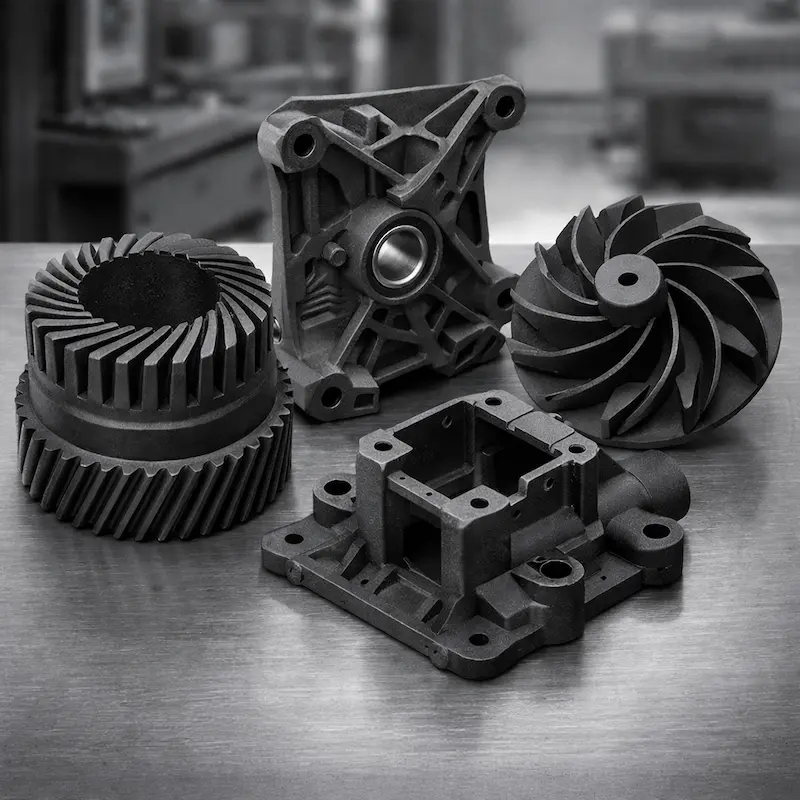
Engineering note: Values below are typical reference ranges. Final manufacturability, tolerances, material condition, surface finish, cost, and lead time depend on the drawing, geometry, quantity, and selected process.
Upload CAD files and mark critical features for an engineering review before production.
| Process | HP MJF 3D printing (glass fiber reinforced nylon) |
|---|---|
| Color | Black (commonly used for functional parts; sandblasting can unify the texture, and painting can create a more consistent appearance) |
| Dimensional tolerance | ±0.20 mm (common reference; it is recommended to mark the tolerance for key holes/datum planes or note "accuracy first/requires secondary processing") |
| Minimum wall thickness | ≥0.8 mm (common reference; it is recommended to be thicker and reinforced near the load-bearing area/screws) |
| Service temperature | About 150℃ (common reference; evaluated based on actual working conditions/structure and duration) |
| Tensile strength | 60–80 MPa (glass fiber reinforcement improves strength and rigidity, suitable for load-bearing structural parts) |
| Density | About 1.02 g/cm³ |
| Surface properties | The surface of MJF has a fine matte grainy feel; sandblasting can further unify the feel and appearance, and painting can achieve a stronger "finished" effect. |
| Assembly enhancements | support Threaded inserts;Please indicate the thread specification (such as M3/M4/M5), quantity and location; please note if enlarging/reaming is required |
| Finishing | Sandblasting, threaded inserts, and painting |
| Typical lead time | Related to size, quantity, placement and finishing; clear delivery and expedited options will be given after uploading the file |
Suitable for functional parts and assemblies: Unify surface touch and look, reduce local powder/texture differences, and be more conducive to batch consistency.
When you need a more "finished" appearance and more stable color difference control, painting is the more direct solution. It is recommended to provide a reference image or texture target (matte/semi-matte).
Used for screw connection and repeated disassembly and assembly; suitable for load-bearing assembly and positioning parts. Please note the thread specifications, quantity and location (with 2D markings if necessary).
Glass fiber reinforcement significantly improves rigidity and structural stability, and is suitable for load-bearing structural parts, brackets, positioning fixtures and assembly reference parts.
It is more friendly to assembly positioning, hole position relationships and repeated delivery; key assembly dimensions can be noted as “accuracy priority/requires secondary processing”.
MJF is good at multiple pieces in parallel and low- to medium-volume production; duplicate pieces of the same style are easier to achieve stable delivery and less rework.
support Threaded inserts Improves the reliability of screw connections; sandblasting/painting can further unify the appearance and feel, suitable for engineering prototypes to small batches.
| Material | Key Advantages | Mainly applicable | Not suitable |
|---|---|---|---|
| HP Nylon - Gray (MJF) | Good batch consistency, stable dimensions, and cost-effective general functional parts | Delivery of low- to medium-volume production of functional parts, assembly positioning parts, and repetitive parts | Rigidity/dimensional stability "extreme priority" (glass fiber reinforcement is better) |
| HP Nylon - Black (MJF) | The same emphasis is placed on consistency and stability. Black is more resistant to dirt and is suitable for functional parts. | Assembly parts, structural parts, small batch repetitive parts | Higher requirements for load bearing/rigidity and dimensional stability (glass fiber reinforcement is better) |
| White Nylon (SLS) | No support required, complex structure is friendly, and functional parts are universal | Structural validation, assembly parts, wear-resistant moving parts, small batch functional parts | "Higher requirements" for batch consistency/dimensional stability (MJF is better) |
| Black Nylon (SLS) | Functionally balanced, wear-resistant and fatigue-resistant, black is more resistant to dirt | Assembly parts, structural parts, wear-resistant parts, functional parts | Load-bearing positioning and dimensional stability limit priority (glass fiber reinforcement is better) |
| Black SLA Resin (SLA) | The appearance details are stronger and the surface is more delicate, suitable for display and review | Appearance prototypes, review samples, display samples, photographic samples | Load-bearing structure and long-term functional use (nylon system is better) |
| Tough SLA - Yellow-Green (SLA) | The resin is more impact-resistant, taking into account both appearance and certain toughness. | Appearance + prototype with certain toughness, buckle verification, light load function verification | Complex structure mass layout, wear-resistant for long-term use (better with nylon) |
It is mainly oriented to functional parts that “give priority to rigidity and dimensional stability”. Typical advantages:
Common references:
For assembly holes/positioning holes, it is recommended to mark the tolerance on the drawing or note "key holes require secondary processing", and use enlarging/reaming when necessary to achieve a more stable fit.
We support mainstream 3D/2D project files:
It is recommended to provide priority STEP + 2D annotation(Clearly written key holes/datums/tolerances), which is more conducive to quick and accurate quote and DFM evaluation.
Suggested remarks: Purpose (load bearing/positioning/assembly) + critical dimensions/tolerances + quantity + appearance requirements + lead time, the quote is closer to your goal.
Finishing supported by this material:
If you require a more consistent look, sandblasting/painting is recommended and provided Reference picture or clear Texture target (matte/semi-matte).
Yes, but it is recommended to give priority to Threaded inserts Improve reliability:
Whether it is suitable for your heat-resistant working conditions needs to be combined with Continuous temperature/time, structural stress, assembly method Comprehensive evaluation; it is recommended to note the working conditions, and we will give manufacturability and material recommendations.
Recommendations: The wall thickness should be as uniform as possible, reinforced, rounded transitions, and assembled in parts if necessary.
If you are going to use it for display or are very sensitive to color difference/texture, it is recommended to spray paint and provide reference pictures.
The lead time is related to the structural complexity, quantity and finishing (sandblasting/painting/threaded inserts will increase the working hours). After uploading the file, we will give you a clear lead time and expedited options.
Process: Upload drawings → Project evaluation and quote → Production and delivery after confirmation.