
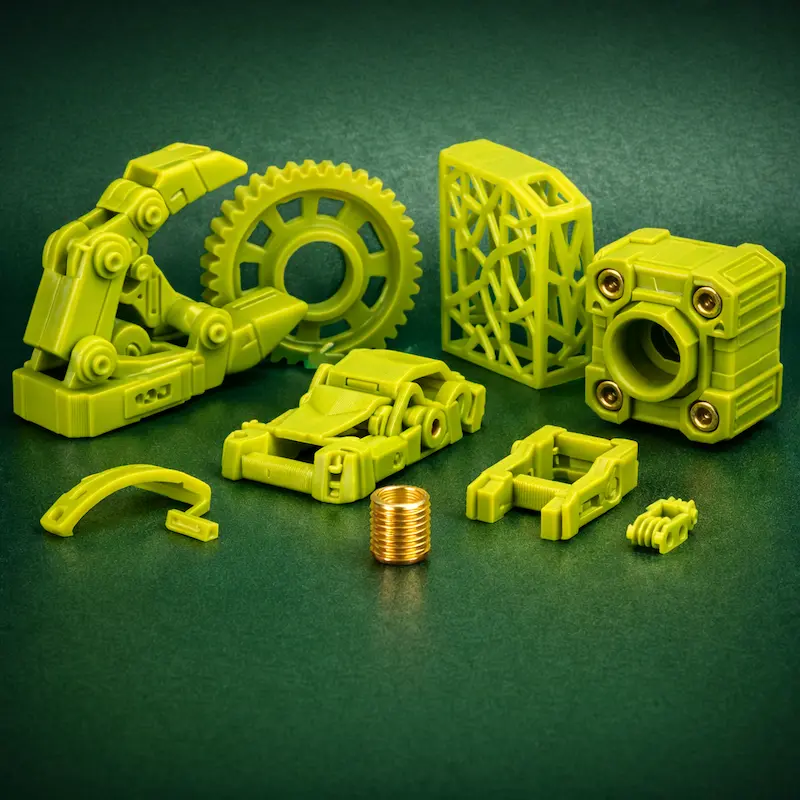
Photosensitive resin toughness-yellow-green SLA 3D printing material (tough SLA resin / impact-resistant SLA photosensitive resin / Tough SLA Resin), oriented towards prototypes and trial parts that "need to be more durable and not prone to brittleness". It is suitable for buckle structures, thin-walled parts, repeated assembly testing and light-load functional validation; while maintaining high precision and good surface quality. Supports grinding, painting, screen printing, vacuum plating and threaded inserts, and can provide quick quotes and lead times.

Tough Resin – Yellow-Green

Tough Resin – Yellow-Green combines SLA detail and surface quality with improved impact resistance for snap fits, thin walls, repeated assembly tests, and functional prototypes.

Tough photosensitive resin (SLA) Impact/cracking resistance Snap verification Repeated assembly testing Thin-walled parts are more stable Appearance + Functional Prototype

Quote checklist: Upload your 3D model and, when available, a 2D drawing. Identify the required process, material, quantity, critical dimensions, finish, appearance standard, and target delivery date.

SLA photosensitive resin tough yellow-green sample: suitable for buckle verification, thin-walled parts and repeated assembly testing, taking into account high precision and surface quality, supports grinding, painting, screen printing, vacuum plating and dental threaded inserts

Key Material and Manufacturing Parameters

Engineering note: Values below are typical reference ranges. Final manufacturability, tolerances, material condition, surface finish, cost, and lead time depend on the drawing, geometry, quantity, and selected process.

Upload CAD files and mark critical features for an engineering review before production.

ProcessSLA light-curing 3D printing (tough photosensitive resin)
ColorYellow-green (easy to distinguish tough resin series; target color and texture can be achieved by painting)
Layer thickness0.05–0.10 mm (commonly used); 0.025 mm high-precision mode (increased lead time/cost)
Dimensional tolerance±0.20 mm or ±0.20% (whichever is greater); it is recommended to mark the tolerance or note "accuracy first" for the key hole/datum surface
Minimum wall thicknessAppearance non-structural ≥0.8–1.0 mm; general structure ≥1.2–1.5 mm; stress/near screws ≥2.0 mm
Minimum apertureDirect forming hole ≥1.5–2.0 mm; it is recommended to reserve allowance for assembly holes/mating holes and ream/ream holes
Text/textureThe height of embossed characters is ≥0.4 mm; the depth of concave characters is ≥0.3 mm; the line width is ≥0.25–0.30 mm (larger is recommended for painting/vacuum plating parts)
Toughness/impact resistanceCompared with standard resin, it is more impact-resistant and less brittle; suitable for buckle verification and repeated trial assembly (it is still recommended to evaluate based on working conditions)
Tensile strength35–60 MPa (related to post-curing/placement direction)
Service temperatureAbout 70–90℃ (short-term verification is more stable; for sustained high temperatures, it is recommended to use high-temperature-resistant resin)
Surface roughnessRa ~1–3 μm (related to layer thickness/direction); grinding + spray coating can further improve appearance consistency
DensityApproximately 1.1 g/cm³
Recommended maximum unit sizeDepends on equipment and placement; oversized pieces can be disassembled and spliced or other processes can be evaluated
Accuracy levelStandard accuracy / high accuracy (remark "key hole/critical surface/tolerance requirements" required)
Assembly enhancements support Threaded inserts; Please indicate the thread specifications (such as M2/M3/M4), quantity and location; please note if tapping/expanding/reaming is required
FinishingPolishing, painting, screen printing, vacuum plating, threaded inserts
Post-cure instructionsPost-curing can improve strength/dimensional stability; for buckle and elastic structures, it is recommended to base the evaluation and process strategy on the "assembly target"
Typical lead timeRelated to size, quantity, placement and finishing; clear delivery and expedited options will be given after uploading the file

Finishing

Sanding (controlling support marks and layering)

Suitable for cleaning the appearance surface/assembly contact surface; it is recommended to keep a reasonable size margin on the buckle and mating surfaces to avoid excessive polishing that affects the fit.

Spray paint (color and texture consistent)

It can be made into matte/semi-matte/high-gloss and other textures to enhance the finished product feel and consistency. It is recommended to provide reference drawings or clarify appearance goals.

Screen printing (logo/scale)

Suitable for logos, scales and other graphic information; it is recommended to provide vector files and location and size instructions.

Vacuum plating (display-grade metal texture)

Used for metallic texture/reflective effect and visual enhancement; suitable for demonstration samples (subject to evaluation of base treatment and appearance standards).

Threaded inserts (repeated assembly is more reliable)

Used for screw assembly and repeated disassembly; suitable for parts that require fixing, assembly verification or small batch assembly (please note the thread specifications, quantity and location).

Why Choose Photosensitive Resin Toughness-Yellow Green (SLA)

More impact resistant than standard resin

It is less prone to brittleness and is suitable for prototypes and light-load functional parts that require "hands-on trial assembly/trialing".

Buckle/thin-wall is more stable

More suitable for buckle verification, trial production of thin-walled structures and slender parts (it is still recommended to do DFM according to working conditions).

Still maintaining high precision and appearance

Taking into account detail presentation and surface quality, it is suitable for projects with mixed demands of "appearance + functional validation".

Finishing and assembly friendly

Supports grinding, painting, screen printing, and vacuum plating; optional when screw connection is required Threaded inserts Improve reliability.

Recommended Applications

  • Snap verification/elastic structure: Structural validation that requires springback, repeated disassembly or assembly or resistance to cracking
  • Repeated trial assembly: Hole position/positioning/interference inspection, requiring multiple assembly tests
  • Thin wall/slender parts: Want to reduce the risk of brittleness and transportation/assembly breakage
  • Appearance + functionality: It requires both details and surface appearance, but also a certain degree of durability.

It is not recommended to use it directly (it is recommended to change materials/processes)

  • Long-term wear-resistant moving parts: It is recommended that nylon (SLS/MJF) is more wear-resistant and more suitable for functional parts
  • Complex structure mass layout: Nylon is more suitable for consistent delivery of low- to medium-volume production
  • Continuous high temperature: It is recommended to use high temperature-resistant resin or heat resistant material system
  • High load and long-term use: It is recommended that engineering plastics/machining/injection molding, etc. are more suitable

Design and DFM Guidelines

  • Buckle and elastic arm: Try to increase the rounded corner transition to avoid stress concentration at sharp corners; if necessary, thicken the root or add ribs to improve fatigue and crack resistance.
  • Assembly holes and fits: It is recommended to leave a margin for the assembly holes; if strict fit is required, please mark the tolerance or note "secondary reaming/reaming/tapping required".
  • Thin wall and large surface: Thin walls can be made but it depends more on the placement direction and support; it is recommended to keep the wall thickness uniform to reduce the risk of warping and deformation.
  • Repeated disassembly and assembly: Screw holes are recommended to be used first Threaded inserts, significantly improving the reliability of repeated disassembly and assembly.
  • Appearance process impact details: Spray painting/vacuum plating will "eat away details". It is recommended to ensure sufficient depth and height for textures and text, and describe the final appearance process in the remarks.

Comparison with common nylon/resin materials

Material Key Advantages Mainly applicable Not suitable
Black SLA Resin (SLA) The details and appearance are strong, suitable for display/review/photography; cost-friendly Appearance prototypes, display parts, photographic samples, light load trial assembly The buckle is repeatedly disassembled and assembled, and has high requirements for impact resistance/fatigue resistance.
White SLA Resin (SLA) Strong versatility, good appearance, friendly finishing, suitable for rapid production of review parts Appearance prototypes, review samples, assembly verification High impact/high durability functional testing
Tough Resin – Yellow-Green More impact-resistant and less brittle than standard resin; appearance and accuracy are still online Snap verification, repeated assembly, thin-walled parts, appearance + functional prototype Batch typesetting of wear-resistant long-term moving parts and complex structures (nylon is better)
Photosensitive resin high temperature-resistant - gray (SLA) Stronger heat resistance and dimensional stability, suitable for thermal environment verification Heat resistance testing, jigs and fixtures, functional samples close to heat sources Repeated disassembly and assembly of buckles that require impact resistance/toughness (needs evaluation)
White Nylon (SLS) The functional type is more stable, does not require support, and is suitable for complex structures and low- to medium-volume typesetting. Structural validation, assembly parts, wear-resistant moving parts, small batch functional parts Ultimate mirror appearance, ultra-high precision fit (requires secondary processing/process change)
HP Nylon & Fiberglass - Black (MJF GF) Stronger rigidity and dimensional stability, suitable for load-bearing structural parts/positioning parts Load-bearing structural parts, assembly positioning parts, functional parts with priority on dimensional stability Fasteners that require a certain degree of elasticity/toughness (needs evaluation)

FAQs