
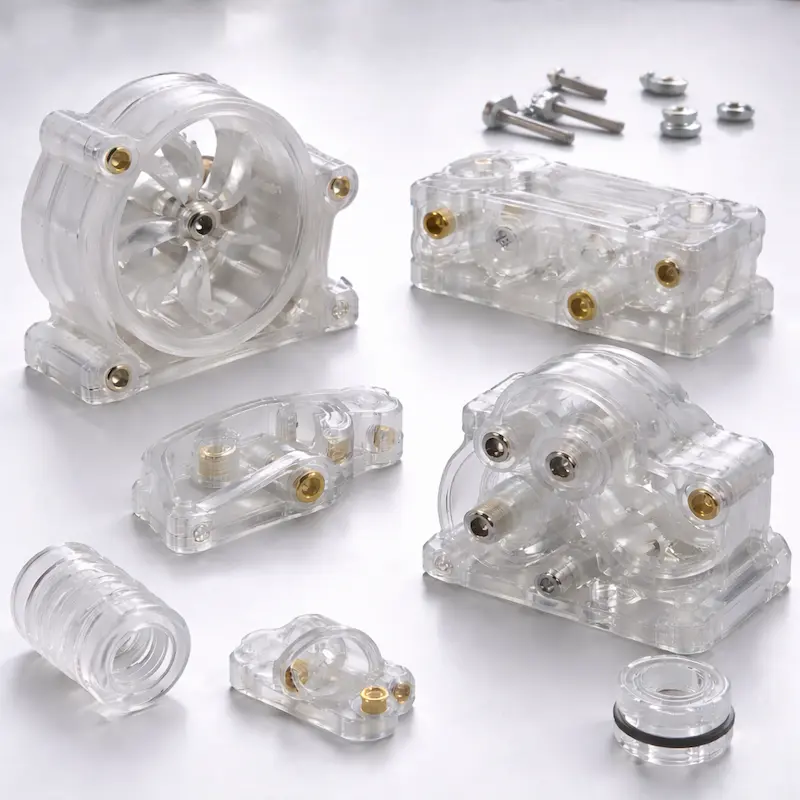
Photosensitive resin translucent SLA 3D printing material (translucent SLA resin / translucent SLA photosensitive resin / Translucent SLA Resin) is suitable for translucent appearance prototypes, visible structural parts, lampshade housings and display samples. It supports grinding and dental threaded inserts, and provides fast quote and delivery.

Translucent Resin

Translucent Resin is used to achieve transparent or semi-transparent display effects and is a common choice for lampshade housings, visual structural components, and transparent display samples.

Transparent photosensitive resin (SLA) Translucent light-transmitting appearance Lampshade/casing visible structural parts Appearance prototype Structural validation

Quote checklist: Upload your 3D model and, when available, a 2D drawing. Identify the required process, material, quantity, critical dimensions, finish, appearance standard, and target delivery date.

SLA photosensitive resin translucent prototype: commonly used for prototypes and visible structural parts with a light-transmitting appearance, with a soft look and feel; supports grinding and threaded inserts

Key Material and Manufacturing Parameters

Engineering note: Values below are typical reference ranges. Final manufacturability, tolerances, material condition, surface finish, cost, and lead time depend on the drawing, geometry, quantity, and selected process.

Upload CAD files and mark critical features for an engineering review before production.

ProcessSLA light-curing 3D printing (transparent photosensitive resin)
ColorTranslucent (soft light transmission; effect is affected by wall thickness/surface condition/disposition direction)
Layer thickness0.05–0.10 mm (commonly used); 0.025 mm high-precision mode (increased lead time/cost)
Dimensional tolerance±0.20 mm or ±0.20% (whichever is greater); it is recommended to mark the tolerance or note "accuracy first" for the key hole/datum surface
Minimum wall thicknessAppearance non-structural ≥0.8–1.0 mm; general structure ≥1.2–1.5 mm; stress/near screws ≥2.0 mm
Minimum apertureDirect forming hole ≥1.5–2.0 mm; it is recommended to reserve allowance for assembly holes/mating holes and ream/ream holes
Text/textureThe height of convex characters is ≥0.4 mm; the depth of concave characters is ≥0.3 mm; the line width is ≥0.25–0.30 mm (it is recommended that the appearance surface be larger)
HardnessShore D 80–88 (varies with formulation/post-cure)
Tensile strength35–55 MPa (usually stronger but more brittle after post-cure)
Elongation at break6–20% (mainly based on appearance and visibility; for toughness requirements, it is recommended to choose tough resin/nylon)
Heat distortion temperature (HDT)HDT (0.45MPa) is about 45–70℃; for high temperature requirements, it is recommended to choose high-temperature resin
Surface roughnessRa ~1–3 μm (related to layer thickness/direction); polishing can improve the look and feel and affect the “transparent/matte” effect
DensityAbout 1.10 g/cm³
Recommended maximum unit sizeDepends on equipment and placement; oversized pieces can be disassembled and spliced or other processes can be evaluated
Accuracy levelStandard accuracy / high accuracy (remark "key hole/critical surface/tolerance requirements" required)
Optional effectsTranslucent body; a more uniform matte/transparent look and feel can be achieved through different polishing strategies (it is recommended to provide reference pictures or effect requirements)
Assembly enhancements support Threaded inserts; Please indicate the thread specifications (such as M2/M3/M4), quantity and location; please note if tapping/expanding/reaming is required
FinishingGrinding and setting threaded inserts
Post-cure instructionsPost-curing can improve strength/temperature resistance and dimensional stability, but may increase brittleness; post-curing is usually recommended for cosmetic parts
Typical lead timeRelated to size, quantity, placement and finishing; clear delivery and expedited options will be given after uploading the file

Finishing

Polishing (determines the look and feel of “transparent vs. matte”)

The look and feel of translucent materials is very dependent on the surface state. It is recommended to polish and transition the display surface more carefully to obtain a more uniform light transmission/matte effect.

Threaded inserts (reliable assembly)

Used for screw assembly and repeated disassembly; suitable for parts that require fixing, assembly verification or small batch assembly (please note the thread specifications, quantity and location).

Why Choose Photopolymer - Translucent (SLA)

Translucent and softer look

Compared with full transparency, translucency is more suitable for the display needs of "soft light/shielding internal details", and the look and feel is more durable and easier to control for consistency.

Strong detail performance (SLA high-precision advantage)

Suitable for small characters, chamfers, textures and thin structures; can be used for appearance review and structural visual verification.

Suitable for visual structure verification

Used for structural validation such as observing internal space, assembly relationships, routing/blocking positions, etc.; key holes/key surfaces can be noted with "accuracy priority".

Assembly can be enhanced

Optional when screw connection/repeated disassembly and assembly is required Threaded inserts Improve reliability and consistency.

Recommended Applications

  • Translucent appearance is preferred:Lampshade/casing, translucent cover, soft light display sample
  • Visual structural validation: Verification and demonstration parts that require “internal structure to be vaguely visible”
  • Appearance + details: SLA has obvious accuracy advantages and is suitable for texture/small text/detail presentation
  • Light load test installation: Assembly verification, interference inspection, and feel evaluation (it is recommended to wear threaded inserts or choose more durable materials after repeated disassembly and assembly)

It is not recommended to use it directly (it is recommended to change materials/processes)

  • Strong impact/high toughness: Switch to more fatigue-resistant solutions such as tough resin or nylon
  • Continuous high temperature: Switch to high-temperature resin or heat-resistant material system
  • High load and long-term use: It is recommended that engineering materials/machining/injection molding, etc. be more suitable
  • Strong weather resistance for long-term outdoor use: Need to evaluate weather-resistant materials and stronger surface protection options

Design and DFM Guidelines

  • For translucent effects, please define the display surface: Support points and processing marks will affect the look and feel; please mark the key display surfaces, and we can give priority to avoiding key surface fabric supports.
  • Wall thickness determines light transmission effect: The thicker the wall, the more "foggy/darker" it is, and the thinner it is, the "more transparent" it is. If you have a target for light transmission, you can write it down in the comments or provide a reference sample.
  • Thin wall/long cantilever: Thin walls can be made, but it depends more on the placement direction and support; it is recommended to thicken/reinforce the key stress-bearing parts to reduce the risk of warping and fracture.
  • Hole location and assembly: It is recommended to leave a margin for small holes/assembly holes; if strict fit is required, please mark the tolerance or note "secondary reaming/tapping/reaming required".
  • Buckle structure: General-purpose transparent/translucent resins are still relatively brittle; the buckles are prone to fatigue after repeated disassembly and assembly. It is recommended to choose tough resin or optimize the structure (rounded corners, thickening, and reducing strain).

Comparison with common nylon/resin materials

Material Key Advantages Mainly applicable Not suitable
Clear SLA Resin (SLA) Transparency/visual effect is stronger, suitable for display needs that emphasize "seeing the inside clearly" Transparent display samples, visible structural parts, lampshade housings Strong impact/long-term durability (tough material or nylon needs to be evaluated)
White SLA Resin (SLA) General-purpose appearance resin with fine surface and greater space for finishing such as spray coating/screen printing Appearance prototypes, review samples, display pieces Translucent appearance requirements (it is recommended to use transparent/translucent resin instead)
Black SLA Resin (SLA) Darker colors are more "finished" and have stronger display and photo-taking effects. Display/review samples, photographic samples, appearance confirmation Translucent display requirements (transparent/translucent resin recommended)
Tough SLA - Yellow-Green (SLA) More impact-resistant than standard resin and more suitable for snap-in/repeated assembly verification Appearance + prototype with certain toughness, buckle verification, light load function verification Translucent appearance requirements (transparent/translucent are more suitable)
White Nylon (SLS) The functional type is more stable, fatigue-resistant, and suitable for complex structures and low- to medium-volume typesetting. Structural validation, assembly parts, wear-resistant moving parts, small batch functional parts Highly transparent appearance display (more suitable for transparent/translucent resin)

FAQs