
Polishing (the assembly surface is more stable)
Polishing and transition processing of the positioning surface and contact surface will help the fit of the fixture and the stability of repeated assembly.
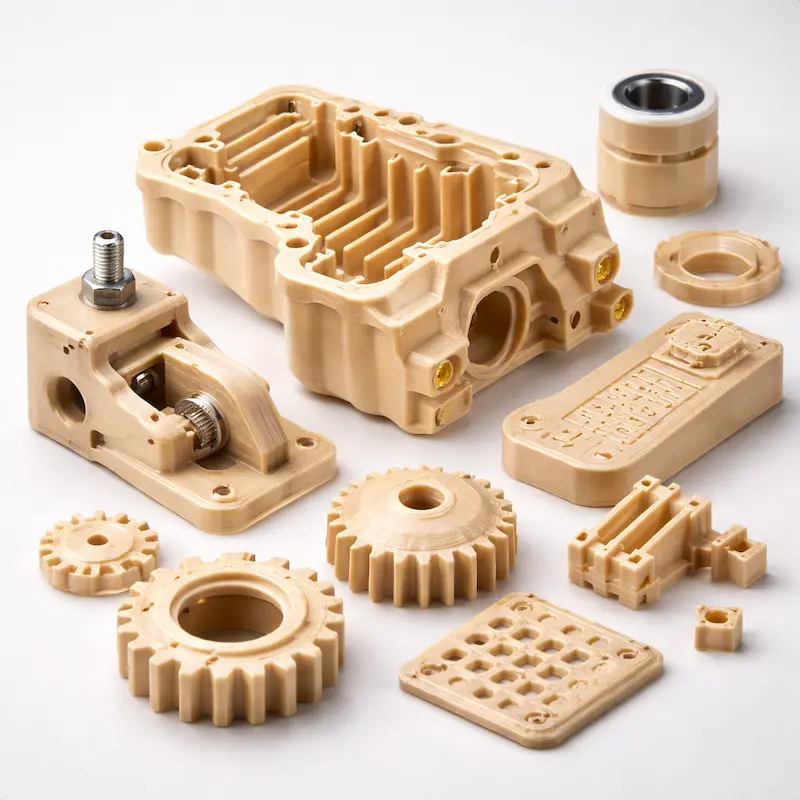
High-Temperature Resin-Beige is an SLA-specialized resin designed for heat resistance requirements, suitable for functional verification or fixture fixtures in high-temperature environments.
Quote checklist: Upload your 3D model and, when available, a 2D drawing. Identify the required process, material, quantity, critical dimensions, finish, appearance standard, and target delivery date.
Engineering note: Values below are typical reference ranges. Final manufacturability, tolerances, material condition, surface finish, cost, and lead time depend on the drawing, geometry, quantity, and selected process.
Upload CAD files and mark critical features for an engineering review before production.
| Process | SLA light-curing 3D printing (high temperature photosensitive resin) |
|---|---|
| Color | Beige (engineering verification makes it easier to observe surface conditions and contact marks; suitable for fixtures and functional samples) |
| Layer thickness | 0.05–0.10 mm (commonly used); higher precision modes need to be evaluated (increased lead time/cost) |
| Dimensional tolerance | ±0.20 mm or ±0.20% (whichever is greater); for thermal environment assembly, it is recommended to mark the critical tolerance or note "precision first" |
| Minimum wall thickness | Non-structural appearance ≥0.8–1.0 mm; general structure ≥1.2–1.5 mm; fixtures/stress areas are recommended to be thicker and reinforced |
| Minimum aperture | Directly formed holes ≥1.5–2.0 mm; it is recommended to reserve a margin for positioning holes/fitting holes and re-expand/ream holes |
| Text/texture | The height of embossed characters is ≥0.4 mm; the depth of concave characters is ≥0.3 mm; the line width is ≥0.25–0.30 mm (larger is recommended for spray paint/screen printing parts) |
| Hardness | Shore D 80–90 (varies with formulation/post-cure) |
| Tensile strength | 40–60 MPa (strength and heat resistance are more stable after post-curing) |
| Elongation at break | 6–15% (High-temperature systems are usually more rigid; for impact/fatigue requirements, it is recommended to choose the toughness/nylon solution) |
| Temperature resistance | Approximately 120–200°C (depending on formulation and post-cure; please evaluate and confirm based on target working conditions) |
| Thermal Stability Recommendations | When used for heat resistance verification/fixtures, it is recommended to evaluate post-curing and thermal cycle conditions to reduce the risk of deformation and dimensional drift. |
| Surface roughness | Ra ~1–3 μm (related to layer thickness/direction); grinding + spray coating can further improve the look and feel and ease of cleaning |
| Density | About 1.10 g/cm³ |
| Recommended maximum unit size | Depends on equipment and placement; it is recommended to disassemble/reinforce large fixtures and assess the risk of thermal deformation |
| Accuracy level | Standard accuracy / high accuracy (remark "key hole/critical surface/tolerance requirements" required) |
| Optional colors | Mainly beige; if a more consistent appearance is required, spray paint can be evaluated (it is recommended to provide color swatches or reference pictures) |
| Assembly enhancements | support Threaded inserts; Please indicate the thread specifications (such as M2/M3/M4), quantity and location; please note if tapping/expanding/reaming is required |
| Finishing | Polishing, painting, screen printing, threaded inserts |
| Post-cure instructions | It is recommended that high-temperature resin be fully post-cured to stabilize heat resistance and dimensional performance; the appearance or fixture parts can be selected according to the requirements for post-curing strength. |
| Typical lead time | Related to size, quantity, placement and finishing; clear delivery and expedited options will be given after uploading the file |
Polishing and transition processing of the positioning surface and contact surface will help the fit of the fixture and the stability of repeated assembly.
It improves look and consistency and makes surfaces easier to clean. If the fixture involves mating surfaces, please indicate this in the remarks to avoid affecting critical dimensions.
Suitable for fixture numbers, direction marks, scales and logos; it is recommended to provide vector files and position and size descriptions.
Used for screw connection and repeated disassembly and assembly to improve the reliability and life of the fixture (please note the thread specifications, quantity and location).
It is more suitable for functional prototypes and fixture applications that are close to heat sources or for short-term thermal testing, reducing the risk of failure due to temperature.
Compared with standard resin, it emphasizes thermal deformation resistance and is more friendly to positioning, assembly, and clamping applications.
Beige is more conducive to observing surface contact marks, slight deformation and detailed boundaries, and is suitable for the "engineering verification first" testing process.
Supports polishing, painting, screen printing and Threaded inserts, it is easier to achieve "usable + maintainable" fixture delivery.
| Material | Key Advantages | Mainly applicable | Not suitable |
|---|---|---|---|
| Photosensitive resin high temperature-resistant - gray (SLA) | Both are heat-resistant systems; engineering verification is more stable and suitable for thermal environment fixtures and functional testing. | Heat resistance verification, jig and fixture, thermal assembly verification | Strong impact/high fatigue long-term use (nylon/tough resin is better) |
| White SLA Resin (SLA) | Universal appearance prototypes are cost-effective and have good details and surface quality. | Appearance prototypes, review samples, general assembly verification | Heat resistance test/scenario close to heat source (high temperature-resistant resin needs to be replaced) |
| Black SLA Resin (SLA) | Darker colors have a stronger finished product feel and are more user-friendly for display/photography | Display parts, photographic samples, appearance review | Heat resistance verification and thermal environment fixtures (high temperature-resistant resin is better) |
| Tough SLA - Yellow-Green (SLA) | More impact-resistant and less brittle, suitable for repeated assembly and buckle verification | Snap/thin-wall verification, light load function verification | Long-term work in high temperature environment (replacement of high temperature-resistant system is required) |
| White Nylon (SLS) | The functional type is more stable, wear-resistant and fatigue-resistant, does not require support, and is suitable for complex structures and batch typesetting. | Structural parts, assembly parts, wear-resistant moving parts, small batch functional parts | Extremely delicate appearance/transparent light transmission effect (need to replace SLA transparent resin) |
It is an SLA specialty resin for "heat-resistant needs". Common uses include:
If your goal is to resist falling, fatigue, and repeated buckling, it is usually more recommended to choose Tough resin or Nylon (SLS/MJF).
Common temperature resistance capabilities can cover approx. 120–200℃ range, but the actual performance is related to the formula, post-curing and stress mode.
For a more accurate assessment, please write clearly in the remarks:
Common references:
In the thermal environment, dimensional drift or slight deformation will occur due to the influence of temperature, force and structure. If there is a critical fit, please provide 2D markings and tolerances, and we will make evaluation recommendations for placement and post-curing.
We support mainstream 3D/2D project files:
Recommended practice (faster and more accurate quote): Priority provided STEP + 2D annotation, and write down the temperature working conditions and key dimensional requirements.
Common optional finishing:
The quote of high temperature-resistant resin not only depends on the volume, but also is affected by the following factors:
It is recommended to write clearly in the remarks: Temperature conditions + usage (fixture/functional validation) + critical dimensions + quantity and lead time, which is more conducive to obtaining a quote plan that is close to the target.
Risks are more likely to occur when the thermal environment and structural design are superimposed. Common high-risk structures:
Suggestions: The wall thickness should be as uniform as possible, the stress points should be reinforced, and if necessary, separate parts should be printed and then assembled, and write down the heat removal conditions in the notes.
It can be used for assembly and clamping, but it is recommended to follow the "durability strategy":
Delivery time depends on structural complexity, quantity, placement and finishing. If high-temperature-resistant resin requires more adequate post-curing and inspection, the overall lead time will increase accordingly.
Expediting is available but may:
Paying extra cost for "high temperature resistance" is generally not recommended if heat resistance testing is not involved:
You can also directly tell us your usage and budget, and we will give you more cost-effective material suggestions.
It is recommended that you also provide/explain when uploading the file:
You only need three steps: Upload drawings → Confirm project evaluation and quote → Production and delivery after confirmation.