
Brushed
Suitable for appearance panels and chassis parts, it is recommended to indicate the drawing direction in the remarks (keeping it consistent with the assembly direction is more "like the finished product").
Stainless steel_SUS430 is one of the ferritic stainless steel plates commonly used in sheet metal fabrication.
Quote checklist: Upload your 3D model and, when available, a 2D drawing. Identify the required process, material, quantity, critical dimensions, finish, appearance standard, and target delivery date.
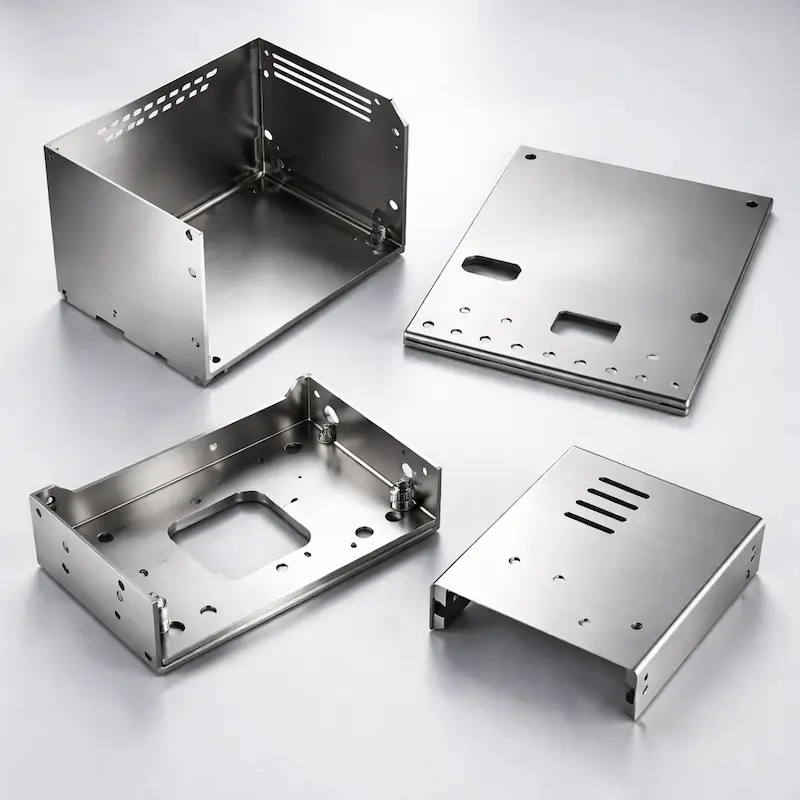
Engineering note: Values below are typical reference ranges. Final manufacturability, tolerances, material condition, surface finish, cost, and lead time depend on the drawing, geometry, quantity, and selected process.
Upload CAD files and mark critical features for an engineering review before production.
| Process | Sheet metal fabrication (laser/stamping + bending + secondary processing/assembly) |
|---|---|
| Material | Stainless steel_SUS430 (commonly used in cost-balancing solutions for cosmetic parts/structural parts) |
| Accuracy | ±0.2 mm |
| Minimum wall thickness | 1.0mm |
| Service temperature | 300–600℃ |
| Tensile strength | 450–1100MPa |
| Density | 7.7–8.5 g/cm³ |
| Recommended plate thickness range | According to drawing requirements; common 0.8–6.0 mm (please note the use and flatness requirements for ultra-thin/extra-thick) |
| Bending recommendations | Please mark the key bending angle, bending edge size, and bending direction in 2D; for cosmetic parts, it is recommended to clarify the drawing direction and bending appearance surface. |
| Holes and Assembly | It is recommended to ream/ream the small hole/fitting hole; it is recommended to indicate the thread specification and depth (such as M3/M4) for the threaded hole. |
| Finishing | Brushing, polishing, electrolytic polishing, passivation, laser engraving |
| Typical lead time | Related to plate thickness, structural complexity, quantity, finishing and assembly process; clear delivery and expedited options will be given after uploading the drawings |
Suitable for appearance panels and chassis parts, it is recommended to indicate the drawing direction in the remarks (keeping it consistent with the assembly direction is more "like the finished product").
Improves appearance brightness and tactility, suitable for exterior parts and visible surfaces; it is recommended to clarify acceptable fine texture standards for high-gloss appearance.
Used to further improve surface finish and cleanliness; suitable for applications more sensitive to surface detail and consistency.
Improves surface corrosion resistance and stability, suitable for humid environments or structural parts/casing parts with higher requirements for rust prevention.
Used for logos, serial numbers, nameplate information and scale marks; it is recommended to provide vector files and location and size instructions.
It is easier to strike a balance between corrosion resistance, strength and cost, and is suitable for stable implementation from prototypes to small batches.
Optional brushing/polishing/electrolytic polishing, etc., suitable for the texture requirements of panels, shells and visual cosmetic parts.
Typical structures such as bent parts, panel parts, brackets and chassis parts are easy to manufacture and control.
Supports laser engraving and passivation treatment, more suitable for projects that require traceability and corrosion resistance stability.
Stainless steel_SUS430 (sheet metal fabrication) is often used for prototype/small batch verification and mass production introduction of cosmetic parts and structural parts, such as panels, chassis shells, brackets, covers and connectors, etc.
If you have clear goals for corrosion resistance or appearance texture, it is recommended to indicate the use environment and appearance grade in the remarks, and we will give more matching material/finishing suggestions.
The more complete the information, the faster the DFM and quote will be, and the closer you will get to your final goal.
Please refer to the key parameters on this page: Accuracy ±0.2, minimum wall thickness 1.0mm(The specifics are still subject to the evaluation of structural form and process route).
If there are key features such as assembly mating holes and positioning holes, it is recommended to clarify the tolerances in 2D and explain the "assembly key holes/critical surfaces" in the remarks.
Stainless steel_SUS430 (sheet metal fabrication) supports: Brushing, polishing, electrolytic polishing, passivation, laser engraving.
Yes. If it includes welding/riveting/riveting nuts/tapping, etc., please clarify the process and location in the drawings and notes, and provide 2D markings to facilitate early assessment of deformation control and surface protection.
Please refer to the parameters on this page: Temperature resistance 300–600℃, tensile strength 450–1100MPa(Subject to material condition and supply specifications).
If your project has sustained high temperature or intensity boundary conditions, please note the working conditions (temperature/load/service life), and engineers will recommend more reliable material selection and structural solutions.
We will confirm bending feasibility, hole location/assembly accessibility and appearance control solutions based on your key requirements.
It is recommended that you submit information in three steps:
Now you can directly Upload drawings and get quotes.