
Sand blasting (unified matte texture)
It is suitable for the "removal/anti-reflection" needs of cosmetic parts and assembly parts; it is also often used as a pre-treatment for subsequent brushing, polishing or marking processes.
304 Stainless Steel is the most commonly used general-purpose austenitic stainless steel, with advantages such as "corrosion resistance and stability, easy material acquisition, and good surface appearance."
Quote checklist: Upload your 3D model and, when available, a 2D drawing. Identify the required process, material, quantity, critical dimensions, finish, appearance standard, and target delivery date.
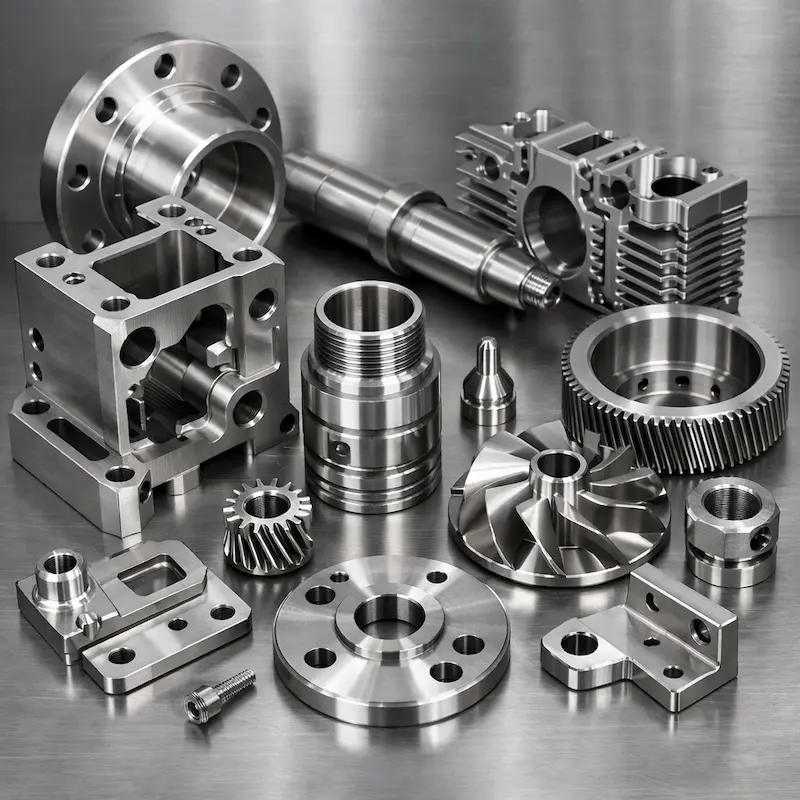
Engineering note: Values below are typical reference ranges. Final manufacturability, tolerances, material condition, surface finish, cost, and lead time depend on the drawing, geometry, quantity, and selected process.
Upload CAD files and mark critical features for an engineering review before production.
| Process | CNC machining (stainless steel 304) |
|---|---|
| Material | Stainless steel 304 (general corrosion resistance, the most widely used; suitable for structural parts/cosmetic parts/connectors) |
| Machining tolerance | ±0.2 mm (common diameter; it is recommended to mark the tolerance or note "precision first" for key holes/critical surfaces) |
| Minimum wall thickness | ≥ 1.0 mm (Thin-walled areas are recommended to be reinforced/thickened or undergo DFM review in advance) |
| Service temperature | 300–600℃ (related to service conditions/duration; please note the working conditions if the temperature is high for a long time) |
| Tensile strength | 450–1100 MPa (related to heat treatment status/feed batch; please note if you need to specify the status) |
| Density | 7.7–8.5 g/cm³ |
| Surface roughness (reference) | Ra 0.8–3.2 μm (varies with process and tool path; mirror/electrolytic polishing can further enhance appearance) |
| Hole/Thread Recommendations | It is recommended to provide 2D marking for deep holes and small threads; for key mating holes, "reservation + reaming/finishing" is commonly used to achieve stable assembly. |
| Finishing | Sand blasting, wire brushing, polishing, electrolytic polishing, passivation, laser engraving |
| Typical lead time | Relevant to structural complexity, quantity, surface finishing and quality inspection standards; clear delivery and expedited options will be given after uploading the file |
It is suitable for the "removal/anti-reflection" needs of cosmetic parts and assembly parts; it is also often used as a pre-treatment for subsequent brushing, polishing or marking processes.
Commonly used in panels, shells and exterior structural parts. It is recommended to note the drawing direction, texture thickness and appearance range to avoid visual inconsistency.
Suitable for cosmetic parts that require "glossy texture"; it is recommended to define the mirror range and allowable fine grain standards to facilitate consistent delivery.
It is more friendly to complex curved surfaces and inner corner areas, and can achieve a more consistent appearance and lower surface residue. It is often used for high-quality cosmetic parts.
Parts suitable for humidity, salt spray or more sensitive environments; it is recommended to indicate in the remarks the usage conditions and whether stricter corrosion resistance requirements are required.
Suitable for identification such as serial numbers, logos, scales and QR codes; it is recommended to provide vector files, position size and contrast requirements.
It performs stably in humid/oily/general chemical media environments, and is a commonly used stainless steel with a good balance of "corrosion resistance + cost + availability".
Suitable for long-term use scenarios of structural parts and connectors; more stable assembly and load-bearing requirements, suitable for end-use parts delivery.
It supports brushing, polishing and electrolytic polishing, and can be flexibly selected from matte to high-gloss, suitable for cosmetic parts and visible parts.
Sandblasting/passivation/radium engraving and other mature combinations are easy to achieve consistent appearance and corrosion resistance standards, and take into account traceability requirements.
304 Stainless Steel is commonly used in structural parts, cosmetic parts, connectors and long-term end-use parts. The core advantages include:
304 Stainless Steel is a general corrosion-resistant choice; when working conditions are more severe, 316/316L is often more stable:
It is recommended to write down the usage environment (whether salt spray/cleaning agent/chemical medium) in the inquiry remarks, and we will match the more appropriate grade and passivation standard according to the working conditions.
Please refer to the "Key Parameters and Points for Ordering" on this page, and the key requirements marked in the drawings/notes shall prevail:
If it involves assembly mating holes, positioning datums or geometric tolerances, please provide 2D annotations (DWG/DXF/PDF) or point out key dimensions in the remarks, and we will conduct accessibility assessment and confirmation based on the part structure.
Common finishing of stainless steel 304 (CNC machining) includes:
For cosmetic parts, it is recommended that you write clearly in the remarks: Appearance surface range + drawing direction/gloss target + acceptable fine lines standard, which can significantly improve consistency and delivery efficiency.
The quote of stainless steel 304 (CNC machining) usually not only depends on the volume, but also is affected by the following factors:
For a faster and more accurate quote, it is recommended to also provide: STEP + 2D annotation (critical dimensions/tolerances) + surface treatment requirements + quantity and lead time.
304 Stainless Steel is a general corrosion-resistant stainless steel, but "corrosion-resistant" does not mean "never corrode". Explicit passivation or higher is recommended in the following situations:
If you are not sure about the working conditions, just write down the usage environment in the notes, and we will give more reliable suggestions.
The key to the consistency of brushed appearance lies in "clear definition + consistent process path":
It is recommended to provide reference pictures or texture samples (closer to the texture and gloss you expect), which can significantly reduce communication costs.
For faster and more accurate quote and evaluation, it is recommended to provide:
If it is an appearance part or assembly, 2D marking is very critical to confirm tolerances, datums and surface requirements, and it is recommended to submit it together with 3D.
Common risks usually come from the combination of "thin walls + deep holes + right inside angles + insufficient accessibility":
You just need to indicate "which dimensions are most critical" in the drawing, and we will give DFM optimization suggestions based on clamping and tool accessibility.
To get a faster and more accurate quote, it is recommended that you also indicate when uploading the file:
The process is usually: Upload drawings → Project evaluation and quote → Production and delivery after confirmation. After uploading, we will provide feedback on quote, DFM suggestions and lead time as soon as possible.