
Sandblasting (unified texture)
Used to remove slight oxidation and processing marks and unify the matte texture; it is recommended to define the appearance surface and sandblasting grade for cosmetic parts.
Cold-rolled plate_SPCC is one of the most commonly used cold-rolled steel plate materials in sheet metal fabrication.
Quote checklist: Upload your 3D model and, when available, a 2D drawing. Identify the required process, material, quantity, critical dimensions, finish, appearance standard, and target delivery date.
Engineering note: Values below are typical reference ranges. Final manufacturability, tolerances, material condition, surface finish, cost, and lead time depend on the drawing, geometry, quantity, and selected process.
Upload CAD files and mark critical features for an engineering review before production.
| Process | Sheet metal fabrication (cutting/bending/stamping/welding/riveting, etc. according to drawings) |
|---|---|
| Material | Cold rolled plate_SPCC (cold rolled steel plate, commonly used for general sheet metal structural parts) |
| Accuracy | ±0.2 mm (common reference; it is recommended to mark the tolerance or note "precision first" for key hole positions/assembly surfaces) |
| Minimum Wall Thickness/Slab Thickness Recommendations | ≥1.0mm (thin plate structure needs to be evaluated based on bending, hole position and strength targets) |
| Service temperature | 300-600℃ (for temperature reference; specific subject to structure, coating and usage conditions) |
| Tensile strength | 450-1100MPa (reference range; subject to actual purchasing materials and standards) |
| Density | 7.7-8.5 g/cm³ |
| Applications | Suitable for scenarios such as prototypes and functional validation, you can choose a more suitable material solution based on appearance, strength, temperature resistance and cost targets. |
| Surface treatment (optional) | Sand blasting, blackening, oxidation, galvanizing, nickel plating, powder coating, painting (select according to appearance and protection objectives; please note the appearance and color/texture) |
| Typical lead time | Related to plate thickness, process (bending/welding/riveting), quantity and surface finishing; clear delivery and expedited options will be given after uploading the file |
Used to remove slight oxidation and processing marks and unify the matte texture; it is recommended to define the appearance surface and sandblasting grade for cosmetic parts.
It is often used for basic rust prevention and appearance deepening of steel parts; it is more suitable for non-strongly corrosive environments. It is recommended to provide reference samples for appearance consistency.
Used to improve surface protection and appearance stability; please clarify the target color and whether subsequent sealing treatment is required.
Suitable for sheet metal parts with higher requirements for rust prevention; please note the coating target and whether it is the appearance surface (affects subsequent appearance control).
Used to improve appearance and corrosion resistance; if higher appearance consistency is required, it is recommended to provide reference standards or sample requirements.
Commonly used in chassis cabinets and shell parts; it has strong wear resistance and covering ability. Please specify the color, texture (fine sand grain/orange grain, etc.) and appearance.
Suitable for color matching and appearance; optional matte/semi-matte/high gloss. It is recommended to provide color numbers or reference images to improve consistency.
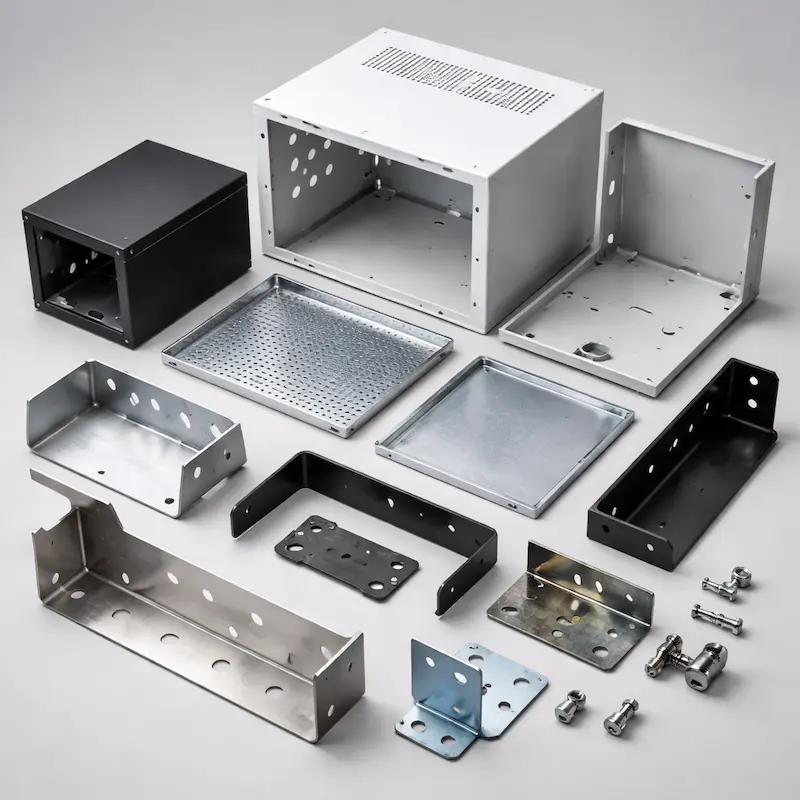
Suitable for most general sheet metal structural parts: shells, brackets, mounting plates, chassis cabinets, etc., convenient for rapid prototyping and small batches.
The cold-rolled surface is smoother, and it is easier to obtain a stable appearance and consistent texture when combined with powder coating/painting/electroplating and other solutions.
It is suitable for bending, stamping and assembly structures; it is also easier to realize parts with multiple bends, ribs and complex hole layouts.
Sandblasting, blackening, oxidation, galvanizing, nickel plating, powder coating, painting and other solutions can be selected according to the anti-rust and appearance objectives.
Cold-rolled plate_SPCC (sheet metal fabrication) is a general-purpose cold-rolled steel plate, commonly used in chassis cabinets, equipment casings, covers, brackets, mounting plates and general structural parts.
If you need to balance cost, appearance and general performance, and want to obtain a stable appearance through powder coating/painting/electroplating, etc., SPCC is a very common choice.
Both can be used: SPCC has a flatter surface and is suitable as a base for painting exterior parts; it can also meet the needs of most general structural parts.
If your key requirements are more corrosion-resistant, wear-resistant or special strength targets, it is recommended to describe the use environment in the remarks, and we will recommend more matching materials or protection solutions.
Please refer to the parameters on this page:
For assembly-sensitive holes/positioning surfaces, it is recommended to provide 2D annotations and clearly specify key tolerances and datums.
Cold rolled plate_SPCC (sheet metal fabrication) optional finishing includes: sandblasting, blackening, oxidation, galvanizing, nickel plating, powder coating, and painting.
SPCC is steel and has a risk of rusting in humid or corrosive environments.
A common approach is to choose Galvanized/nickel plated or Powder coating/paint to improve protection capabilities; if the environment is more harsh, consider upgrading to stainless steel or a stronger protection system.
Suitable. Cold-rolled plate_SPCC is often used for bending and assembly structures. The process route can include cutting, bending, stamping, welding, riveting, etc. (processed according to drawings).
If welding and appearance surfaces are included, please indicate the appearance requirements and weld treatment objectives in the remarks for evaluation and quote.
Common risk points include:
It is recommended to provide 2D markings and clarify critical surfaces, tolerances and appearance grades. We can do a DFM review before quoting.
It is recommended to provide 3D + 2D annotations to improve quote accuracy:
If it is a bent part, please try to provide bending information or clarify the bending requirements in the drawing.
Sheet metal parts quote is usually not only related to area, but also affected by the following factors:
It is recommended to state when uploading files:
You only need three steps: Upload drawings → Confirm project evaluation and quote → Production and delivery after confirmation.