
trimming
Used for appearance edge finishing and appearance closing; if you have high requirements for appearance edges, it is recommended to note "appearance surface/display surface".
Soft Rubber(typically PU/Rubber-Like TPU elastomers or rubber-like casting resins) is used in vacuum casting to produce flexible prototypes with "greater wear resistance/tear resistance/stronger rebound," suitable for soft-touch components and cushioning/protective parts requiring certain strength.
Quote checklist: Upload your 3D model and, when available, a 2D drawing. Identify the required process, material, quantity, critical dimensions, finish, appearance standard, and target delivery date.
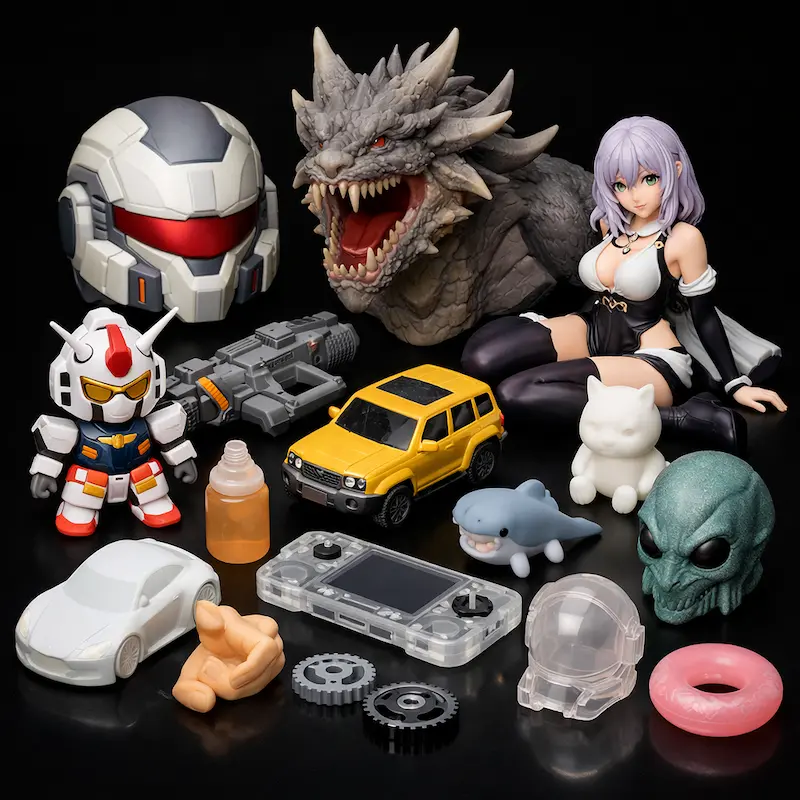
Engineering note: Values below are typical reference ranges. Final manufacturability, tolerances, material condition, surface finish, cost, and lead time depend on the drawing, geometry, quantity, and selected process.
Upload CAD files and mark critical features for an engineering review before production.
| Process | Vacuum Casting |
|---|---|
| Material type | plastic |
| Material subcategory | soft plastic |
| Accuracy | ±0.2 mm |
| Minimum wall thickness | 1.0mm |
| Service temperature | 300-600℃ |
| Tensile strength | 450-1100MPa |
| Density | 7.7-8.5 g/cm³ |
| Applications | Suitable for scenarios such as prototypes and functional validation, you can choose a more suitable material solution based on appearance, strength, temperature resistance and cost targets. |
| Finishing | Trimming, removing edges, dyeing |
| Typical lead time | Relevant to structural complexity, quantity and finishing requirements; clear delivery and expedited options will be given after uploading the file. |
Used for appearance edge finishing and appearance closing; if you have high requirements for appearance edges, it is recommended to note "appearance surface/display surface".
Used to deal with marks such as edges and parting lines; it is recommended to mark parts that are sensitive to feel/appearance in drawings or notes.
To achieve target color or appearance consistency; please provide color number/reference image and indicate if batch consistency control is required.
Suitable for prototypes that require "soft touch/flexible characteristics" for appearance review and experience verification.
It can be used for functional validation prototypes; it is recommended to write down the stress mode and usage conditions in the remarks to facilitate more suitable solution suggestions.
Supports trimming, stripping and dyeing, making it easier to balance appearance and delivery pace.
It is suitable for making a comprehensive trade-off between cost, appearance and performance; when the demand is more "hardcore", the materials can be upgraded or the process route can be adjusted.
Soft Rubber is suitable for scenes such as appearance prototypes and functional validation, especially for samples that require "flexible feel/soft features".
For faster and more accurate evaluation, it is recommended to note the following when uploading the file: purpose (appearance prototype/functional validation), quantity, lead time and key working conditions.
The key parameters of the soft rubber (vacuum-cast parts) material library include: accuracy (±0.2), minimum wall thickness (1.0mm), temperature resistance (300-600℃), tensile strength (450-1100MPa), and density (7.7-8.5 g/cm³).
Important suggestions when placing an order: Indicate whether staining is required, which surfaces are sensitive to appearance (edge/parting line), and whether key assembly dimensions have 2D markings.
The material library gives a minimum wall thickness reference of 1.0mm. Actual manufacturability also depends on structural continuity, thickness changes, and appearance requirements.
Suggestions: Avoid sudden changes in thickness and thickness, and increase fillet transitions; please provide working condition descriptions for key areas (assembly/stress) to facilitate DFM review.
The quote of soft glue (vacuum-cast parts) is usually affected by the structural complexity, appearance requirements, finishing (edging/removal/dying), quantity and lead time.
If you want a quote that is closer to your target, it is recommended to write clearly in the remarks: usage, appearance acceptance criteria, whether to dye, quantity and lead time.
When you are sensitive to edge/parting lines, it is recommended that you define the "display surface/appearance surface" in the drawings or notes and state the acceptable mark standards.
We will combine chip removal and edge trimming strategies to prioritize appearance performance and prompt high-risk areas during the DFM stage.
If you need to specify a color or a more consistent look, it is recommended to select Dyeing And provide color number/reference picture.
If there are batch consistency requirements, please state it in the remarks (for example: exhibition samples, photography samples, multiple batches of repurchases need to be consistent).
It is recommended to add when uploading the file: the force mode (tension/compression/bending), temperature range, whether it comes into contact with oil/water/solvent and other media, and the assembly method.
This information can help better match your Strength/Temperature Resistance/Appearance/Cost goals during the DFM and material recommendation stages.
It is recommended to provide STEP + 2D annotation (PDF/DWG) and mark the critical dimensions/tolerances and datum planes in the notes.
The reference accuracy of the material library is ±0.2; if you have stricter assembly requirements, please clarify the "key holes/key surfaces/fitting methods" to facilitate individual evaluation.
All you need is: Upload files → Confirm project evaluation and quote → Place order for production and delivery.