
sandblasting
Used to homogenize the surface and improve paint adhesion; for cosmetic parts, it is recommended to define key surfaces and roughness expectations in the remarks.
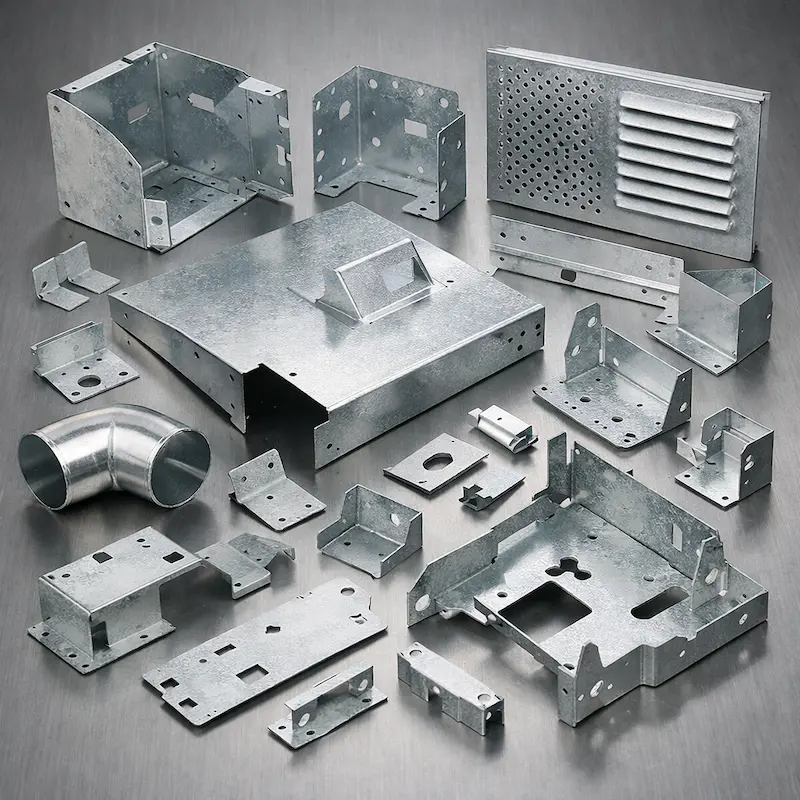
Hot-dip galvanized steel plate_SGCC (sheet metal fabrication) is documented with typical properties, suitable applications, finishing options, and design guidance for Sheet Metal Fabrication.
Quote checklist: Upload your 3D model and, when available, a 2D drawing. Identify the required process, material, quantity, critical dimensions, finish, appearance standard, and target delivery date.
Engineering note: Values below are typical reference ranges. Final manufacturability, tolerances, material condition, surface finish, cost, and lead time depend on the drawing, geometry, quantity, and selected process.
Upload CAD files and mark critical features for an engineering review before production.
| Process | Sheet metal fabrication (cutting/bending/punching/riveting/welding, etc., select combined process according to drawings and structure) |
|---|---|
| Material name | Hot-dip galvanized steel plate_SGCC |
| Accuracy | ±0.2 mm |
| Minimum wall thickness | 1.0mm |
| Service temperature | 300-600℃ |
| Tensile strength | 450-1100MPa |
| Density | 7.7-8.5 g/cm³ |
| Requirements tag | low cost common parts, Corrosion resistant |
| Typical applications | Shell/cover, box, bracket, mounting plate, general sheet metal structural parts (surface finishing matched according to structure and environmental requirements) |
| Typical lead time | Related to plate thickness, structural complexity, quantity and finishing; clear delivery and expedited options will be given after uploading the file |
| Finishing | Sand blasting, blackening, oxidation, galvanizing, nickel plating, powder coating, painting |
Used to homogenize the surface and improve paint adhesion; for cosmetic parts, it is recommended to define key surfaces and roughness expectations in the remarks.
It is suitable for scenes that require dark appearance and certain protection requirements; if spray coating/electroplating is required later, please indicate the process priority in advance.
Used for surface protection and appearance treatment; if there are conductive grounding requirements or partial shielding requirements, please mark them in the drawings/notes.
Used to improve corrosion resistance and durability; if the parts contain welding or high-appearance surfaces, it is recommended to perform DFM evaluation processing sequence first.
Used to further enhance surface protection and appearance consistency; the impact of coating thickness must be considered for mating surfaces/threads/hole locations.
Suitable for cases where both appearance and durability are taken into consideration, such as shells/boxes; please note the acceptance criteria for color, gloss, texture and key surfaces.
Suitable for color consistency and appearance grade control; can be implemented according to matte/gloss and color number requirements. It is recommended to provide reference pictures for more accuracy.
Suitable for structural and shell parts that are more sensitive to corrosion; it is easier to obtain stable protection performance under general working conditions.
When used for general sheet metal parts, cost and manufacturability are taken into consideration, and it is suitable for rapid iteration from prototypes to small batches.
It can be combined with cutting, bending, punching, riveting and other sheet metal processes to achieve structural forming, and is suitable for box/bracket structures.
Supports sandblasting, blackening, oxidation, galvanizing, nickel plating, powder coating, and painting, which can be achieved according to the combination of appearance and protection goals.
Hot-dip galvanized steel sheet_SGCC is commonly used in shells/covers, brackets, boxes and general sheet metal structural parts. The core advantages are concentrated in:
For faster and more accurate quote, it is recommended to provide 3D + 2D (if there are critical dimensions/tolerances):
If there are any important appearance surfaces (Side A), coating color/gloss, welding requirements, etc., please write them clearly in the remarks.
Material data available for reference:
If there are assembly mating holes, positioning datums or critical bending dimensions, it is recommended to mark and note "key dimensions first" in the 2D drawings.
Hot-dip galvanized steel sheet_SGCC sheet metal quotes are usually related to the following factors:
Hot-dip galvanized steel plate_SGCC supports finishing including: sandblasting, blackening, oxidation, galvanizing, nickel plating, powder coating, and painting.
If the part contains welding, please indicate in the drawing/notes:
We will combine the structure and finishing routes to give more reliable processing suggestions and quotes.
It is recommended that you do the following when submitting information:
When holes are densely located or openings are close to edges/bends, common risks include deformation, insufficient local strength, or reduced processing stability.
It is recommended to mark in the drawings: Key holes, allowable deformation range, hole-to-edge/hole-to-bend restrictions, we will give manufacturability and optimization suggestions in DFM.
In order to be closer to the target appearance and acceptance criteria, it is recommended to write clearly in the remarks:
It is recommended that you also provide/explain when uploading the file:
You only need three steps: Upload drawings → Confirm project evaluation and quote → Production and delivery after confirmation.