
sandblasting
Used to remove slight oxidation and processing marks to obtain a more uniform matte texture; also often used as surface pretreatment before powder coating/painting.
Q235 (sheet metal fabrication) is documented with typical properties, suitable applications, finishing options, and design guidance for Sheet Metal Fabrication.
Quote checklist: Upload your 3D model and, when available, a 2D drawing. Identify the required process, material, quantity, critical dimensions, finish, appearance standard, and target delivery date.
Engineering note: Values below are typical reference ranges. Final manufacturability, tolerances, material condition, surface finish, cost, and lead time depend on the drawing, geometry, quantity, and selected process.
Upload CAD files and mark critical features for an engineering review before production.
| Process | Sheet metal fabrication (cutting/stamping/bending/welding/assembly) |
|---|---|
| Material | Q235 (low-cost general carbon steel) |
| Accuracy | ±0.2 mm |
| Minimum wall thickness | 1.0mm |
| Service temperature | 300-600℃ |
| Tensile strength | 450-1100MPa |
| Density | 7.7-8.5 g/cm³ |
| Design Tips (Sheet Metal) | It is recommended to specify in the drawings: Plate thickness, bending angle/radius, hole to edge distance, assembly datum; If you need to match it with other parts, please mark the key hole locations and tolerances, or state "assembly first/appearance first" in the remarks. |
| Finishing | Sand blasting, blackening, oxidation, galvanizing, nickel plating, powder coating, painting |
| Typical lead time | Related to plate thickness, structural complexity, quantity, welding/assembly and finishing; clear delivery and expedited options will be given after uploading the file |
Used to remove slight oxidation and processing marks to obtain a more uniform matte texture; also often used as surface pretreatment before powder coating/painting.
Improves appearance consistency and provides certain rust resistance; suitable for indoor structural parts, fixture brackets and other projects that require a black appearance.
It is used to form a surface protective layer and improve appearance stability; if the requirements for corrosion resistance are higher, it is recommended to use environmental assessment in conjunction with a more suitable solution.
One of the common anti-rust solutions, suitable for humid environments, outdoors or sheet metal parts that require corrosion resistance.
Used to improve corrosion resistance and appearance texture; suitable for parts that have certain requirements for surface decoration or wear resistance (need to be combined with structure and cost evaluation).
Powder coating has strong coverage, wear resistance, and good appearance consistency; often used for enclosures, shells, and brackets for end-user visible components.
The color and gloss are controllable, suitable for small batches of cosmetic parts and projects that require quick matching of appearance effects; color numbers/reference pictures can be given in the remarks.
Suitable for most structural component prototypes and functional validation; quickly advance project iterations under a controllable budget.
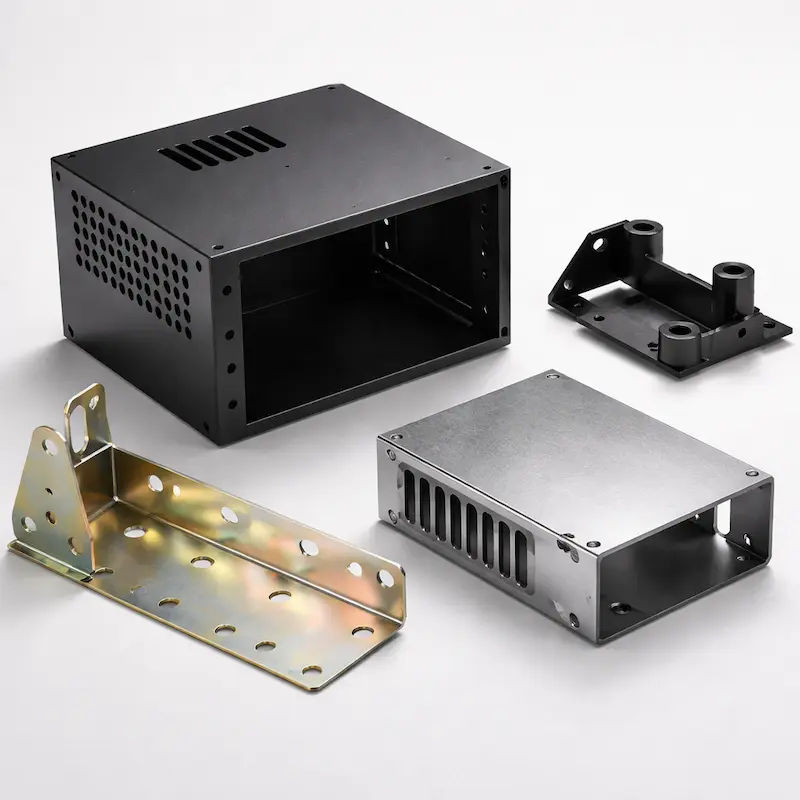
The cutting, bending, welding and assembly paths are mature and suitable for typical sheet metal structures such as shells, brackets, and chassis cabinets.
It supports common appearance solutions such as powder coating/painting; at the same time, anti-rust surface finishing can be made to adapt to the use environment.
Materials are highly available and suitable for small batches and multi-batch iterations; uploading drawings can quickly evaluate quotes and lead times.
Q235 (sheet metal fabrication) is suitable for general structural parts such as shells, brackets, mounting plates, chassis cabinets, etc. It is often used in the prototype and functional validation stages. It is characterized by cost-friendly, mature technology, and high delivery efficiency.
Q235 is carbon steel and there is a risk of rusting in humid or outdoor environments. A common practice is to choose galvanizing, powder coating or painting according to the environment; indoor structural parts can also be blackened or sandblasted to improve appearance and consistency.
Please refer to the parameters on this page: accuracy ±0.2, minimum wall thickness 1.0mm. If there are key assembly hole positions/datum planes, it is recommended to provide 2D markings and mark the key tolerances, and we will conduct targeted assessment and confirmation.
It is recommended to provide 3D + 2D markings for faster and more accurate quote:
Usually related to plate thickness, unfolded size, bending/welding complexity, number of holes and slots, assembly process, finishing (powder coating/galvanizing, etc.) as well as quantity and lead time. It is recommended to write down the purpose, quantity, lead time and appearance/anti-rust requirements in the remarks.
Q235 (sheet metal fabrication) supports: sandblasting, blackening, oxidation, galvanizing, nickel plating, powder coating, and painting. Generally speaking: galvanizing/powder coating/painting favors rust prevention and appearance coverage; sandblasting favors surface uniformity and pretreatment; blackening favors black appearance and certain protection; nickel plating favors corrosion resistance and appearance texture.
It is recommended to clarify in the remarks: appearance surface definition (front/visible side), color/color number, gloss (matte/high gloss), texture preference (fine sand/flat), scratch tolerance and whether rust resistance level is required (indoor/outdoor). It is better to have reference pictures.
Common risks include: deformation caused by holes too close to edges or bend lines, incomplete bending information (missing angle/radius/direction), and appearance and size deviation caused by welding heat effects. It is recommended to provide clear 2D annotations and mark critical assembly holes and datums.
For outdoor/humid environments, it is recommended to give priority to galvanizing, or combine powder coating/painting on the basis of galvanizing to obtain better protection and appearance consistency. If there are grounding conductivity or assembly coordination requirements, please explain them in advance so that both function and protection can be taken into consideration.
It is recommended that you also provide/explain when uploading the file:
In this way, we can provide a project evaluation (DFM) faster and a quote plan that is closer to your goals.