
chamfer
Used to remove sharp edges, improve assembly and feel; more friendly to appearance and safety.
Polyvinyl Chloride (PVC)(Polyvinyl Chloride) is an engineering plastic with excellent flame retardancy and chemical corrosion resistance, and can be adapted into hard or soft materials according to the formulation.
Quote checklist: Upload your 3D model and, when available, a 2D drawing. Identify the required process, material, quantity, critical dimensions, finish, appearance standard, and target delivery date.
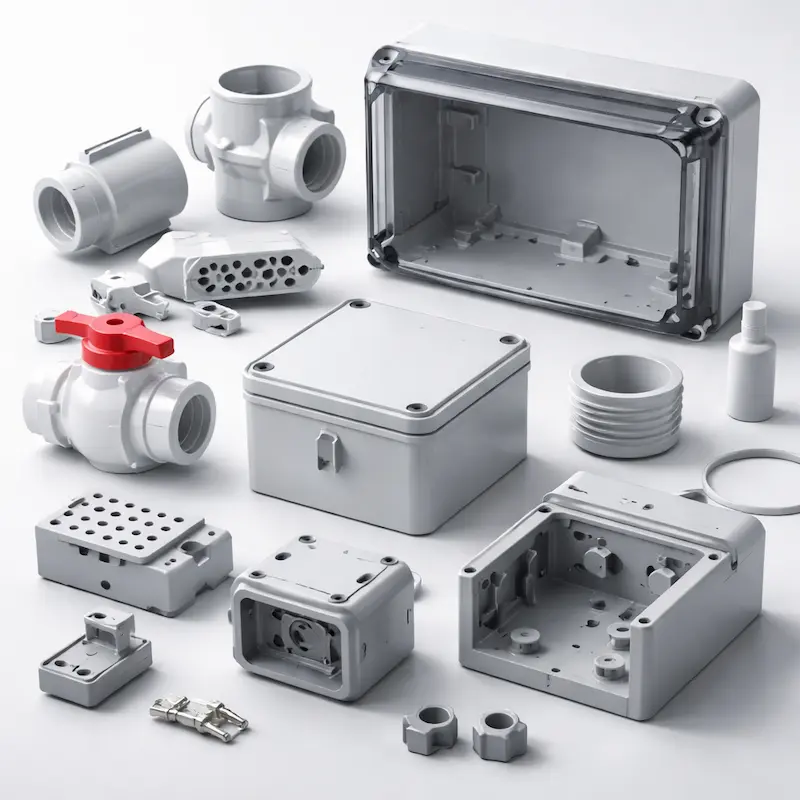
Engineering note: Values below are typical reference ranges. Final manufacturability, tolerances, material condition, surface finish, cost, and lead time depend on the drawing, geometry, quantity, and selected process.
Upload CAD files and mark critical features for an engineering review before production.
| Process | Injection Molding |
|---|---|
| Material name | PVC (polyvinyl chloride) |
| Accuracy | ±0.2 mm |
| Minimum wall thickness | 1.0mm |
| Service temperature | 300-600℃ |
| Tensile strength | 450-1100MPa |
| Density | 7.7-8.5 g/cm³ |
| Requirements tag | Low cost general parts / corrosion resistant / electrical insulation |
| Finishing | Chamfering, grinding, bonding, screen printing, laser engraving |
| Typical delivery | Related to the mold plan, quantity, appearance standards and finishing; a clear quote and lead time will be given after uploading the file |
Used to remove sharp edges, improve assembly and feel; more friendly to appearance and safety.
Used to improve surface details and appearance consistency; it can be graded in accordance with appearance standards.
Suitable for separate assembly, extended parts or scenes with limited structure; it is recommended to note the bonding surface and strength/sealing objectives.
Suitable for logos, scales and logos; it is recommended to provide vector files and position and size instructions to facilitate alignment and batch consistency.
For use with serial numbers, QR codes and permanent identification; it is recommended to specify contrast targets and acceptable surface texture variations.
Suitable for low-cost general parts and large-scale production needs, it is easier to strike a balance between budget and delivery.
Suitable for parts exposed to common media and humid environments (please note the specific media and temperature to facilitate material/formula evaluation).
It can be used for insulating structural parts and protective parts; if there are any withstand voltage/creepage distance/certification requirements, please indicate them in the drawings or remarks.
Supports chamfering, grinding, bonding, screen printing, and laser engraving, adapting to appearance marking and assembly delivery scenarios.
PVC (polyvinyl chloride) injection molded parts are often used for cost sensitive and need Corrosion resistant or electrical insulation Parts, such as structural parts, shells, protective parts, insulating brackets, etc.
It is recommended to note the usage environment (medium/temperature/time) and appearance requirements when uploading files to facilitate more accurate selection and quote.
PVC can be made into partial shape according to the formula Rigid (rigid PVC) Or partial Flexible (soft PVC) Direction. To avoid deviation, it is recommended to note:
This page provides the reference key parameters of this material under this process:
If you have critical assembly dimensions or tolerance targets, it is recommended to provide 2D annotations for use in conjunction with structural assessments.
Finishing supported for PVC (Injection Molding) includes:
Yes. It is recommended to provide:
Yes. If you want to laser engrave the QR code/serial number, it is recommended to note:
Injection molding quote usually not only depends on the material, but also is strongly related to the following factors:
It is recommended to provide the following when uploading files:
After submission, we will give DFM suggestions based on the structure and provide feedback on feasible process and quote plans.