
chamfer
It is used to remove sharp edges, reduce the risk of edge chipping, and improve the feel and safety of assembly. It is recommended to mark the chamfer size or "sharp edge removal" on the drawings.
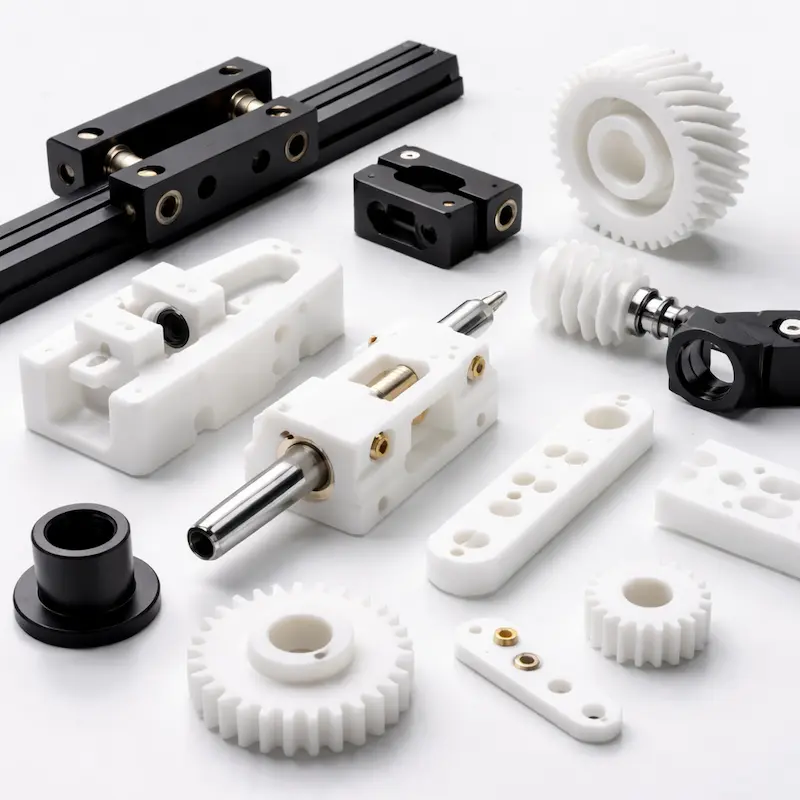
Acetal (POM) features "dimensional stability, low friction, wear resistance, and good machinability," making it a cost-effective choice for CNC machining plastic parts.
Quote checklist: Upload your 3D model and, when available, a 2D drawing. Identify the required process, material, quantity, critical dimensions, finish, appearance standard, and target delivery date.
Engineering note: Values below are typical reference ranges. Final manufacturability, tolerances, material condition, surface finish, cost, and lead time depend on the drawing, geometry, quantity, and selected process.
Upload CAD files and mark critical features for an engineering review before production.
| Process | CNC Machining |
|---|---|
| Material | Acetal POM (polyoxymethylene POM) |
| Common colors | Mainly natural color (milky white/white); black and other colors are subject to stock plates and rods |
| General machining accuracy | ±0.2 mm (regular capability; please mark tolerances or note "accuracy first" for key dimensions/fits) |
| Minimum wall thickness recommendations | ≥ 1.0 mm (Thinner structures need to evaluate the risks of clamping, vibration and deformation) |
| Holes/Slots and Fittings | It is recommended to define the mating hole by "base + tolerance"; it is recommended to indicate the assembly method and allowable deformation of the interference/press-fit structure. |
| Chamfer/fillet recommendations | It is recommended that the edges be chamfered to relieve stress and prevent edge chipping; the inner corners should be rounded as much as possible to match the tool radius and reduce the risk of cracking. |
| Surface expression | The surface of POM is relatively "waxy/low surface energy". When the appearance requirements are high, it is recommended to clarify the polishing level and directionality requirements. |
| Typical applications | Gears, sliders, bushings, guides, bushings, fixtures, wear-resistant structural parts |
| Finishing | Chamfering, grinding, bonding, screen printing, laser engraving |
| Typical lead time | Related to size, quantity, number of processing surfaces and finishing; clear delivery and expedited options will be given after uploading the file |
It is used to remove sharp edges, reduce the risk of edge chipping, and improve the feel and safety of assembly. It is recommended to mark the chamfer size or "sharp edge removal" on the drawings.
Used to improve the feel of knife grain and edges; if you are sensitive to appearance consistency, it is recommended to note the grinding direction, key surfaces and acceptable texture standards.
Suitable for assembly and fixation after component processing; please indicate the bonding surface, positioning method and strength requirements in the remarks to facilitate the evaluation of the structure and process.
Suitable for logos, scales and marking information; it is recommended to provide vector files and position and size instructions, and indicate the direction and visible surface.
Used for permanent identification (numbering/QR code/Logo, etc.); please provide content files and position reference to avoid engraving in areas subject to strong force or critical coordination.
Suitable for sliding guides, rotating supports and transmission structures, commonly found in sliders, bushings and gear parts.
Under reasonable structure and load conditions, POM has stable wear resistance and is suitable for structural parts with "repeated motion/contact".
Suitable for part manufacturing that require matching relationships; it is recommended that key hole slots and datums be clearly defined with 2D tolerances.
CNC is suitable for rapid iteration and small batch delivery; it can also cooperate with Laser engraving/screen printing Implement identification and version management.
Acetal POM (polyoxymethylene POM) is more suitable for Wear-resistant, low friction, requires smooth movement Structural parts, such as:
If you are more concerned about high temperatures, strong bonding, or paint appearance consistency, it is recommended to note the working conditions and we can assist in evaluating alternative materials.
The advantages of POM usually focus on:
Therefore, it is often used in "moving parts/wear-resistant parts" such as gears, sliders, guides and bushings.
It is recommended that "coordination" be clearly stated, which is more critical than just writing the size:
Commonly recommended minimum wall thicknesses are ≥ 1.0 mm. Thinner structures are not impossible, but they will be more dependent on:
If you have thin-walled/slender parts, it is recommended to do a DFM review first, and we will give structural and processing suggestions.
The finishing supported by Acetal POM (polyoxymethylene POM) includes:
If you need logo management (number/QR code/version), laser engraving is usually more durable; screen printing is optional for appearance logos and scales.
POM has a lower surface energy and bonding reliability often requires structural fit with process evaluation Do it together. Suggestions:
It is recommended that you give priority to clarifying in the drawings/notes:
Quotes are usually determined by a combination of the following factors:
We support mainstream project files:
Want to be faster and more accurate: suggestions STEP + 2D annotation, and write down the key tolerances, fits and uses in the remarks.
In order to get a faster and more accurate quote, it is recommended that you also indicate when uploading the file:
You only need three steps: Upload drawings → Confirm project evaluation and quote → Production and delivery after confirmation.