
polish
Used to remove slight knife lines and edge burrs to improve the consistency of touch and appearance; it is recommended to clarify the direction of the grain and the acceptable standards for the appearance.
Polypropylene (PP) is known for its "chemical corrosion resistance, low density, and low cost," suitable for acid and alkali/chemical resistant plastic structural parts and container components.
Quote checklist: Upload your 3D model and, when available, a 2D drawing. Identify the required process, material, quantity, critical dimensions, finish, appearance standard, and target delivery date.
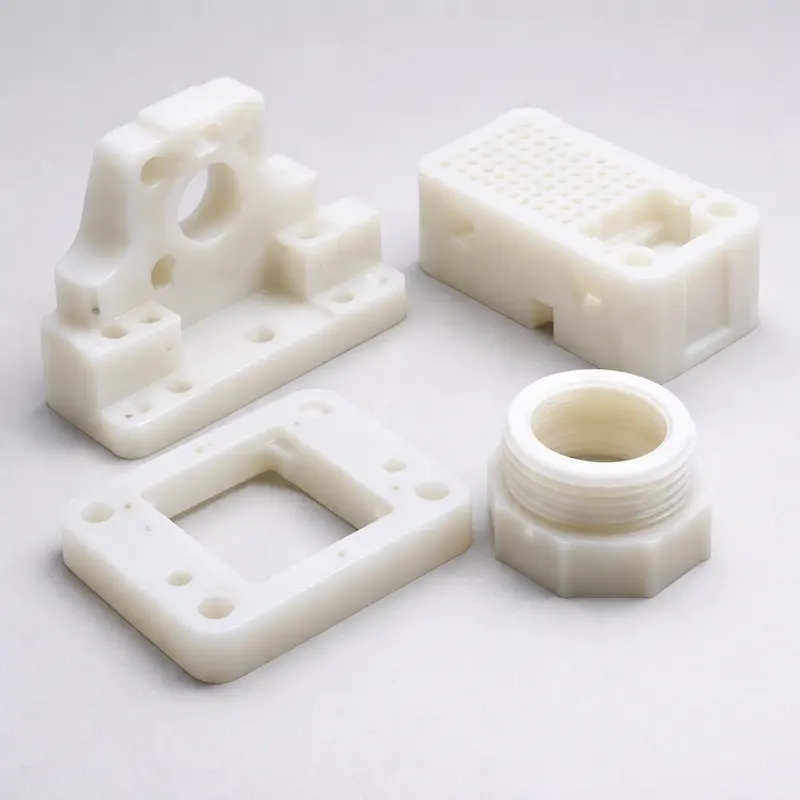
Engineering note: Values below are typical reference ranges. Final manufacturability, tolerances, material condition, surface finish, cost, and lead time depend on the drawing, geometry, quantity, and selected process.
Upload CAD files and mark critical features for an engineering review before production.
| Process | CNC machining (PP engineering plastics) |
|---|---|
| Color | True color (commonly milky white/translucent white); painting and marking solutions can be evaluated as needed |
| Dimensional tolerance | Conventional ±0.10 mm; high accuracy up to ±0.05 mm (related to size, structure and clamping, it is recommended to mark key tolerances) |
| Minimum wall thickness | General structure ≥1.0–1.5 mm; it is recommended to reinforce or thicken larger flat surfaces/long thin-walls to reduce the risk of deformation |
| Minimum aperture | Recommended ≥1.5–2.0 mm; please note or provide process requirements for deep holes/small holes (can be expanded/reamed) |
| Thread/Assembly | Can be tapped; for repeated disassembly and assembly, it is recommended to evaluate metal inserts or structural reinforcement (depending on the structure and stress) |
| Density | About 0.90 g/cm³ (lightweight advantage is obvious) |
| Tensile strength | About 25–35 MPa (affected by grade and crystallinity) |
| Elasticity/Toughness | Good toughness and good fatigue resistance; but rigidity and wear resistance may not be better than POM/PA |
| Service temperature | Short-term temperature resistance can be higher; long-term operating temperature is usually recommended to be in a lower range (please evaluate high temperature environments first) |
| Chemical resistance | It is more stable for most acid-base/aqueous media; for strongly oxidizing media/solvents, it needs to be confirmed according to the working conditions. |
| Electrical properties | Good insulation performance, suitable for insulating structural parts (specific dielectric indicators can be confirmed upon request) |
| Surface quality | It can achieve a delicate machined surface; if the requirements for the appearance surface are high, it is recommended to define the appearance surface and grain direction. |
| Typical lead time | Relevant to size, quantity, structural complexity and finishing; clear delivery and expedited options will be given after uploading the file |
| Finishing | Polishing, screen printing, laser engraving, painting |
Used to remove slight knife lines and edge burrs to improve the consistency of touch and appearance; it is recommended to clarify the direction of the grain and the acceptable standards for the appearance.
Used to unify color and texture (matte/high gloss, etc.); it is recommended to provide reference pictures, color and appearance definitions.
Suitable for logos, scales and other graphic information; it is recommended to provide vector files and location and size instructions.
Suitable for durable marks such as serial numbers, QR codes, and functional logos; please note the content, location, and contrast requirements.
Low density, suitable for weight-sensitive structural parts and assemblies.
It is more stable in humid/water media and most acid and alkali environments, and is suitable for structural parts in related working conditions.
Suitable for applications such as electrical insulation structural parts, isolation gaskets and protective parts.
support Polishing, painting, screen printing and laser engraving, to facilitate clearer brand/functional identification and unified appearance.
Polypropylene (PP) is often used in fixtures, insulating structural parts, light-load functional parts and water-resistant/chemical-resistant parts. Its advantages are concentrated in:
PP is more "corrosion resistant + lightweight" and may not be optimal for the following requirements:
It is recommended that the key requirements marked on the drawings prevail, and you can also refer to the experience values on this page:
If there are mating holes/locating surfaces, please provide 2D markings and benchmarks, and we will conduct a DFM assessment based on the clamping and process route.
We support mainstream project files:
Faster and more accurate way: STEP + 2D critical dimensioning, and write down the purpose, quantity, lead time and appearance/labeling requirements in the remarks.
PP CNC machining quote is usually determined by the following factors:
Common optional finishing for polypropylene-PP (CNC machining) includes: Polishing, screen printing, laser engraving, painting.
It can be used for general cosmetic parts or functional appearance integrated parts, but please note:
Usually tapping and assembly verification can be done, but it is recommended to be more cautious about stress and repeated disassembly and assembly:
PP is more "soft", and thin walls and large planes require more structural constraints. Suggestions:
In order to get a faster and more accurate quote, it is recommended that you provide/explain when uploading the file:
You only need three steps: Upload drawings → Confirm project evaluation and quote → Production and delivery after confirmation.