
chamfer
Used to remove sharp edges and improve assembly import; it is recommended to clarify the chamfer size or give instructions for assembly edges, handheld edges and stress-sensitive areas.
Polyether Ether Ketone (PEEK)(polyether ether ketone) is a high-performance specialty engineering plastic with extremely high mechanical strength, excellent high-temperature resistance, and outstanding chemical corrosion resistance.
Quote checklist: Upload your 3D model and, when available, a 2D drawing. Identify the required process, material, quantity, critical dimensions, finish, appearance standard, and target delivery date.
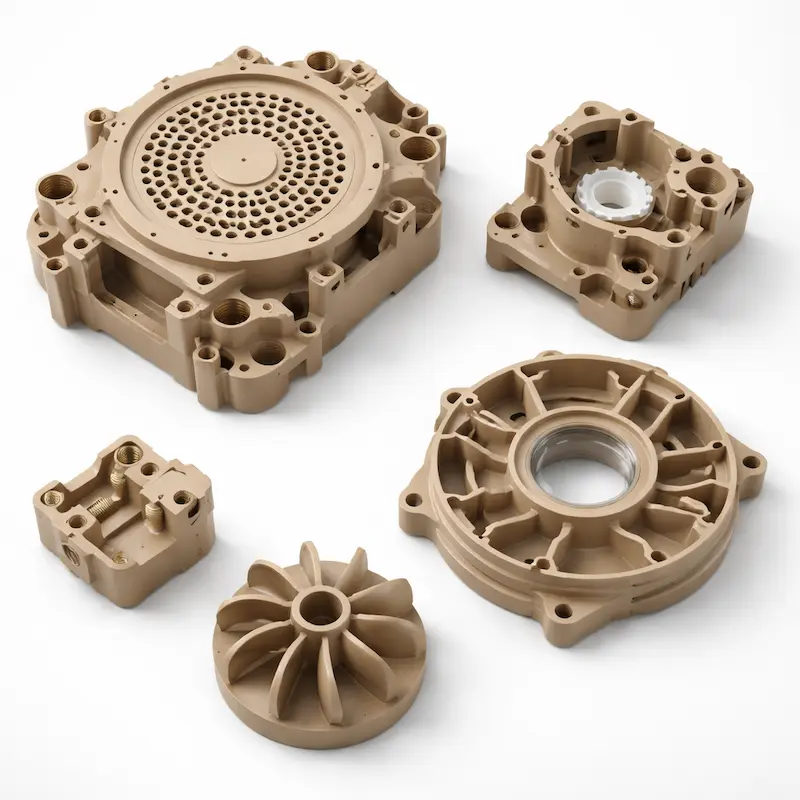
Engineering note: Values below are typical reference ranges. Final manufacturability, tolerances, material condition, surface finish, cost, and lead time depend on the drawing, geometry, quantity, and selected process.
Upload CAD files and mark critical features for an engineering review before production.
| Process | Injection Molding |
|---|---|
| Material | PEEK (polyetheretherketone) |
| Accuracy | ±0.2 mm |
| Minimum wall thickness | 1.0mm |
| Service temperature | 300-600℃ |
| Tensile strength | 450-1100MPa |
| Density | 7.7-8.5 g/cm³ |
| Typical application directions | High temperature-resistant functional parts, corrosion resistant structural parts, electrical insulation related parts, lightweight structural parts (aiming at injection molding consistency and batch delivery). |
| Finishing | Chamfering, grinding, bonding |
| Typical lead time | Relevant to structural complexity, mold/jigs requirements, quantity and inspection requirements; clear delivery and expedited options will be given after uploading the file |
Used to remove sharp edges and improve assembly import; it is recommended to clarify the chamfer size or give instructions for assembly edges, handheld edges and stress-sensitive areas.
Used to improve the local appearance and feel of the mating surface; if there are appearance requirements, please define acceptable parting line/gate/ejector mark standards.
Suitable for component structure, assembly positioning and functional assembly; it is recommended to reserve positioning structure and bonding gaps in the drawings, and note the force direction and usage environment.
Suitable for functional parts scenarios that are close to heat sources, thermal environment verification or are more sensitive to dimensional stability (subject to confirmation of specific brand and working conditions).
It is more stable in some medium environments and is suitable for structural parts related to chemical/moisture/oil pollution and other working conditions (it is recommended to clearly indicate the medium and temperature in the remarks).
When there are requirements for the integration of insulation and structure, it is easier to make "functional parts", and the consistency can be improved through structure and mold solutions.
When you want to move from small batch verification to mass production delivery, injection molding is beneficial to stabilizing batch consistency and unit cost dilution.
PEEK (polyetheretherketone) injection molding is more suitable for functional parts and end-use parts that are more sensitive to performance, such as high-temperature-resistant related parts, corrosion-resistant environmental structural parts, electrical insulation directional parts, etc.
If you are more concerned about "low cost + fast delivery", you can also explain the goals and working conditions in the remarks, and we will help evaluate a more suitable material solution.
Temperature resistance is strongly related to "continuous temperature/peak temperature/stress state/medium environment/service life". It is recommended that you write clearly in the remarks:
The clearer the information, the more accurate the DFM and materials recommendations will be.
The key parameters on this page come from material data to help you quickly assess feasibility:
The actual performance will vary depending on the specific grade/modification system and mold plan; if you need more stringent indicators or designated grades, please consult an engineer.
Common risks for injection molded parts include sink marks, warpage, weld line effects, and ejection/gate marks that affect appearance. Common practices to reduce risk:
PEEK (polyetheretherketone) injection molding quote is usually affected by the following factors:
For a faster and more accurate quote, it is recommended that you provide:
If there are key assembly dimensions, it is recommended to submit the "STEP + 2D annotation" combination.
Parting line, gate, and ejector marks are strongly related to mold structure. If you are more sensitive to appearance, it is recommended:
The finishing of this page is subject to the material data. The finishing of PEEK (polyetheretherketone) injection molded parts is: Chamfering, grinding, bonding.
If you need additional appearance craftsmanship or special secondary processing, please make a note when uploading the file, and we will give feasible suggestions based on the part structure and goals.
Delivery time usually depends on structural complexity, need for molds/jigs, quantity and inspection requirements. The following situations are more likely to extend the lead time:
After uploading the documents, we will give you a clear lead time and expedited options.
It is recommended that you write clearly when uploading the file:
You only need three steps: Upload drawings → Confirm project evaluation and quote → Production and delivery after confirmation.