
chamfer
Used to remove sharp edges and improve assembly feel and safety; especially useful for appearance edges and assembly guide surfaces.
Polyethylene (PE)(polyethylene) is a widely used type of general-purpose plastic with excellent chemical corrosion resistance, impact resistance, and good flexibility.
Quote checklist: Upload your 3D model and, when available, a 2D drawing. Identify the required process, material, quantity, critical dimensions, finish, appearance standard, and target delivery date.
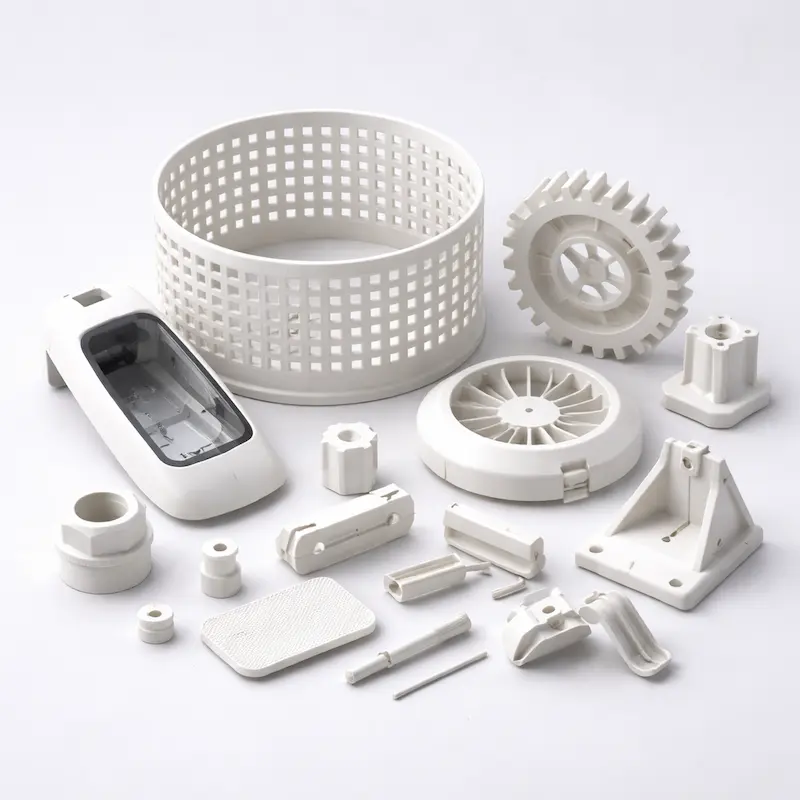
Engineering note: Values below are typical reference ranges. Final manufacturability, tolerances, material condition, surface finish, cost, and lead time depend on the drawing, geometry, quantity, and selected process.
Upload CAD files and mark critical features for an engineering review before production.
| Process | Injection Molding |
|---|---|
| Material | PE (polyethylene) |
| Positioning | Low cost general purpose parts/corrosion resistant applications |
| Accuracy | ±0.2 mm |
| Minimum wall thickness | 1.0mm |
| Service temperature | 300-600℃ |
| Tensile strength | 450-1100MPa |
| Density | 7.7-8.5 g/cm³ |
| Finishing | Chamfering, grinding, bonding, screen printing, laser engraving |
| Typical lead time | Related to structural complexity, mold plan, quantity and finishing; clear delivery and expedited options will be given after uploading the file |
Used to remove sharp edges and improve assembly feel and safety; especially useful for appearance edges and assembly guide surfaces.
Used to improve local feel and surface consistency; if there are clear standards for appearance, it is recommended to provide reference drawings or acceptance requirements.
Suitable for assembly and packaging of component structures; please note the bonding location, strength requirements and whether the adhesive line needs to be hidden on the exterior surface.
Suitable for logos, scales and other graphic information; it is recommended to provide vector files and clarify the location, size and color requirements.
Suitable for serial numbers, QR codes and durable markings; please provide a content list and engraving location instructions to quickly confirm the feasibility of the process.
It is suitable for rapid implementation in budget-sensitive projects, making it easier to achieve cost control from prototype verification to batch injection molding.
When parts need to be exposed to certain chemical media or humid environments, engineering evaluation and selection recommendations can be made based on the media and temperature conditions.
Suitable for repetitive parts and large-scale production; the larger the quantity, the less mold and preparation costs can be diluted.
Supports chamfering, grinding, bonding, screen printing and laser engraving to facilitate productized appearance and traceability marking.
PE (polyethylene) is often used in injection molding for low-cost general parts and parts requiring corrosion resistance, and is suitable for transitioning from prototype/functional validation to mass production.
When your key requirements are more strength, temperature resistance, wear resistance or ultimate appearance and texture, PE (polyethylene) may not be the best solution. It is recommended to simultaneously evaluate higher performance engineering plastics or adjust the process route.
The reference values given by the source data of this material are as follows (the actual ones are subject to structure, mold and process control):
If there are requirements for critical hole positions/locating surfaces/sealing surfaces, etc., it is recommended to provide 2D markings and indicate tolerances to facilitate priority control and confirm manufacturability.
For a faster and more accurate quote, it is recommended to provide 3D + 2D (if there are tolerance/assembly requirements). Commonly supported formats:
If only STL is provided, it is recommended that the critical dimensions be supplemented by 2D or notes for more accurate evaluation and quote.
PE (polyethylene) injection molding quote is usually not only related to volume, but also affected by the following factors:
The finishing supported by PE (polyethylene) injection molding is as follows (subject to material data):
If you require a more complex surface solution, please write down your target appearance and acceptance criteria in the comments, and we will evaluate the feasible paths and cost implications.
In order to more accurately evaluate the corrosion resistance suitability of PE (polyethylene), it is recommended to write clearly in the remarks:
The more complete the information, the more reliable the material and structure suggestions given, and the more conducive it is to confirm the quote and lead time at one time.
The reference values given by the source data of this material are:
Since different grades and molding conditions will significantly affect the actual performance, if you have hard targets for temperature resistance/strength, please explain the goals and test methods in the drawings or notes, and we will give you suggestions based on engineering evaluation that are more relevant to your working conditions.
Common design-level control ideas include:
In order to get a faster and more accurate quote, it is recommended that you provide/explain when uploading the file:
You only need three steps: Upload drawings → Confirm project evaluation and quote → Production and delivery after confirmation.