
chamfer
Used to remove sharp edges and improve assembly and feel consistency; if there are appearance surfaces and assembly surfaces, please prioritize them in the notes.
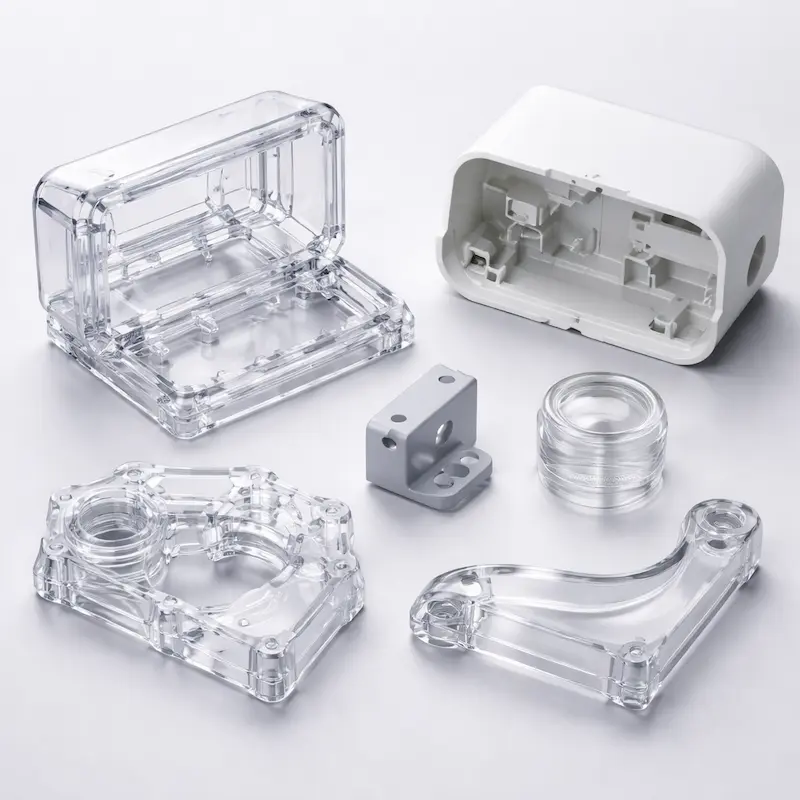
Polycarbonate (PC) is a high-performance engineering plastic with extremely high impact strength, excellent transparency, and high heat resistance.
Quote checklist: Upload your 3D model and, when available, a 2D drawing. Identify the required process, material, quantity, critical dimensions, finish, appearance standard, and target delivery date.
Engineering note: Values below are typical reference ranges. Final manufacturability, tolerances, material condition, surface finish, cost, and lead time depend on the drawing, geometry, quantity, and selected process.
Upload CAD files and mark critical features for an engineering review before production.
| Material name | PC (polycarbonate) |
|---|---|
| Process | Injection Molding |
| Requirements tag | Appearance prototype, electrical insulation |
| Accuracy | ±0.2 mm |
| Minimum wall thickness | 1.0mm |
| Service temperature | 300-600℃ |
| Tensile strength | 450-1100MPa |
| Density | 7.7-8.5 g/cm³ |
| Finishing | Chamfering, grinding, bonding, screen printing, laser engraving, polishing (transparent edge) |
| Quote entrance | /quote/?material=pc&process=injection-molding |
Used to remove sharp edges and improve assembly and feel consistency; if there are appearance surfaces and assembly surfaces, please prioritize them in the notes.
It is used to improve the surface appearance and remove fine flow marks/edge processing marks; the higher the appearance standard, the more investment in polishing and quality inspection.
Suitable for component assembly and structural combination; it is recommended to provide assembly direction, bonding surface requirements and assembly tolerances to facilitate stable and consistent implementation.
Suitable for logos, scales and logos; it is recommended to provide vector files and location dimensions, and clarify the appearance and acceptable color difference range.
Suitable for serial numbers, QR codes and wear-resistant logos; please provide content, size and location, and clarify whether slight whitening or surface texture changes are allowed.
Used to improve transparent edges or local translucency; please specify the polishing range, appearance surface and assembly benchmark in the drawings/notes to avoid affecting coordination.
Suitable for appearance prototype and functional validation projects, making it easier to make a trade-off between budget and delivery efficiency.
It is suitable for structural parts/casing parts that require insulation properties, and can be further evaluated based on the structure and standards.
Supports screen printing and laser engraving, making it easy to create brand logos, parameter scales and traceability information.
Optional polishing (transparent edge) improves visual effect; suitable for designs that require partial transparency or edge appearance.
PC (polycarbonate) injection molding is often used for appearance prototypes and functional validation parts, and is also suitable for structural parts/shell designs that require electrical insulation. After uploading the drawings, more matching process and finishing suggestions can be given based on the usage and appearance standards.
It is recommended to refer to the drawing markings and assembly requirements; if not marked, you can first refer to the common parameter range (accuracy and minimum wall thickness) on the page. It is recommended to provide 2D markings for key hole locations/datum planes and indicate "precision first".
PC (polycarbonate) injection molding supports chamfering, grinding, bonding, screen printing, laser engraving and polishing (transparent edge). Different finishing will affect appearance standards, quality inspection methods and lead times; it is recommended to write down the priority and target effect in advance in the remarks.
Polishing (transparent edge) is suitable for parts that require edge translucency or local visual enhancement. It is recommended to clarify in the remarks: the polishing range (which edge/which area), the definition of the appearance surface, whether it is the assembly reference surface, and the acceptable appearance standards (slight waviness/gloss consistency).