
chamfer
Removes sharp edges and improves assembly feel and safety; especially recommended for parts that require frequent handling or assembly.
Polycarbonate (PC) effect resin is used in vacuum casting for functional prototypes with "higher impact resistance/higher temperature resistance," suitable for structural components requiring toughness, drop impact resistance, or certain thermal load.
Quote checklist: Upload your 3D model and, when available, a 2D drawing. Identify the required process, material, quantity, critical dimensions, finish, appearance standard, and target delivery date.
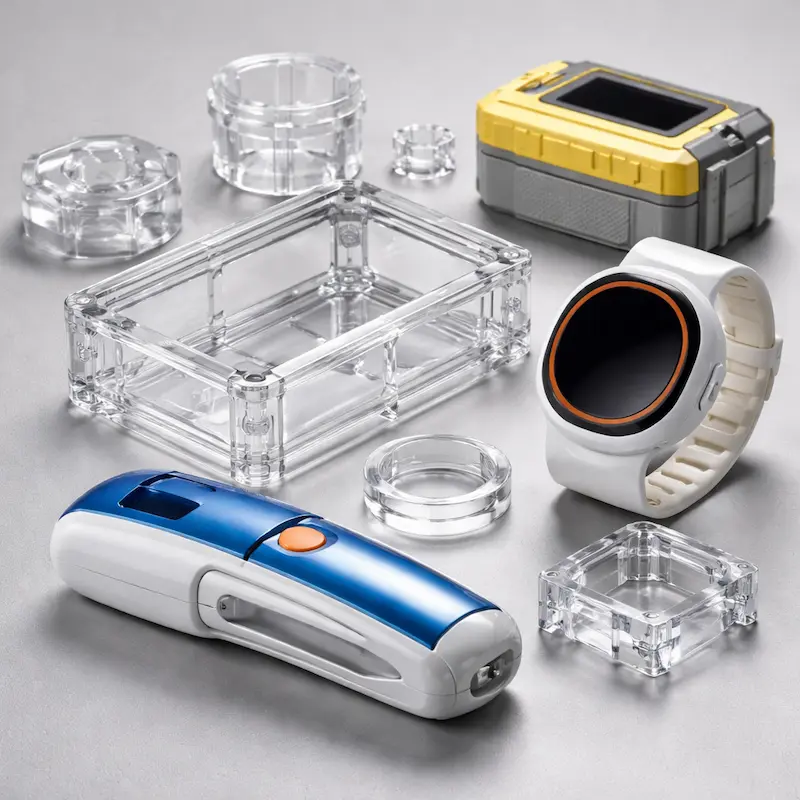
Engineering note: Values below are typical reference ranges. Final manufacturability, tolerances, material condition, surface finish, cost, and lead time depend on the drawing, geometry, quantity, and selected process.
Upload CAD files and mark critical features for an engineering review before production.
| Process | Vacuum casting (silica gel mold/Vacuum Casting) |
|---|---|
| Material | Polycarbonate (PC) (vacuum casting system, aiming to achieve a molding solution close to the appearance and feel of PC) |
| Typical accuracy | ±0.20 mm (common reference; it is recommended to mark the tolerance or note "precision first" for key holes/mating surfaces) |
| Minimum wall thickness | ≥1.0 mm (recommended; risks of outgassing, shrinkage and deformation need to be assessed for thin walls/large flat surfaces) |
| Transparent/Translucent | Assessable (structure and process are sensitive; it is recommended to choose a polishing/spray coating solution and clarify appearance standards) |
| Strength and toughness | More interested in "injection molding feel" and functional validation; in long-term high load/high fatigue scenarios, it is recommended to switch to injection molding or CNC |
| Service temperature | Evaluate based on the specific molding system and usage conditions (if you are close to a heat source, please note the operating temperature and duration) |
| Finishing | Chamfering, grinding, bonding, screen printing, laser engraving, painting, polishing (transparent edge) |
| Typical lead time | Related to structural complexity, quantity, mold splitting plan and finishing; clear delivery and expedited options will be given after uploading the file |
Removes sharp edges and improves assembly feel and safety; especially recommended for parts that require frequent handling or assembly.
Improve parting lines, gates and small corrugations; the appearance surface can be finely polished according to standards to improve consistency.
Suitable for structural assembly after separate parts are copied; it is recommended to reserve space for positioning and glue joints in the design, and indicate strength/appearance priority.
Suitable for logos, scales, logos and other graphic information; it is recommended to provide vector files and location and size instructions.
For use with durable markings and serial numbers; clear zone, font height, and contrast goals recommended.
Achieve opacity/specified color and uniform texture (matte/high gloss); spray coating solution is recommended when high appearance consistency requirements are required.
Used to improve the light transmission performance of transparent or translucent areas; it is recommended to define the "transparent window/transparent edge" range and appearance standards in advance.
Compared with injection molding, the mold opening threshold is lower, and it is suitable for trial production, verification and small batch delivery of 10-200 pieces.
It is easier to obtain a look and feel close to that of plastic parts, which is suitable for review, display and functional validation.
Supports painting, screen printing, laser engraving, etc., making the sample closer to the "deliverable appearance standard".
For structures that require transparent/translucent edges, polishing (transparent edges) can be used to optimize the visual effect (needs to be combined with structural evaluation).
Polycarbonate (PC) is often used for appearance prototypes, review samples and small batch functional validation. The advantages are concentrated in:
Vacuum casting is more suitable for "small batches/rapid iterations", while injection molding is more suitable for "medium and large batches/long-term stable mass production".
When in doubt, upload the file and note the quantity and usage, and we will give process comparison and suggestions.
Commonly used reference accuracy is ±0.20 mm, but will be affected by structure, pouring and finishing.
If there are key holes/key mating surfaces, please provide 2D markings or mark the key dimensions in the remarks, and we will individually evaluate and provide an achievable solution.
Recommended minimum wall thickness ≥1.0 mm. Air bubbles, local shrinkage or slight deformation may occur on thin walls/large flat surfaces.
If the wall must be thin, it is recommended to provide appearance standards and stress conditions. We will optimize the exhaust and mold splitting plan and give structural improvement suggestions.
Recommendation: STEP + 2D marking (or remarking key dimensions/tolerances) is more conducive to quick and accurate quote.
Support: Chamfering, grinding, bonding, screen printing, laser engraving, painting, polishing (transparent edge).
Remarks: It is recommended to write clearly: appearance surface definition, color/transparency target, whether bonding assembly is required, whether there are critical dimensions/tolerances and delivery requirements.
Vacuum castings usually have controllable parting lines and gate trimming marks, and complex structures may also have slight bubbles or surface textures.
It can be evaluated, but the transparent/translucent effect is more sensitive to structure and process:
It is suitable for assembly verification and functional validation of a certain strength. However, if it involves "repeated snapping/repeated disassembly/assembly/long-term stress", it is recommended:
The lead time is related to the structural complexity, mold opening and molding rounds, quantity and finishing. To speed up delivery, we recommend: