
chamfer
It is used to remove sharp edges and improve assembly safety and feel; it is also more friendly to assembly introduction and sliding contact surfaces.
Compared to Nylon (PA)6, Nylon 66 (PA66) offers "higher rigidity, greater temperature resistance, better wear resistance, and (relatively)" dimensional stability, making it suitable for plastic functional parts that are more sensitive to strength and heat resistance.
Quote checklist: Upload your 3D model and, when available, a 2D drawing. Identify the required process, material, quantity, critical dimensions, finish, appearance standard, and target delivery date.
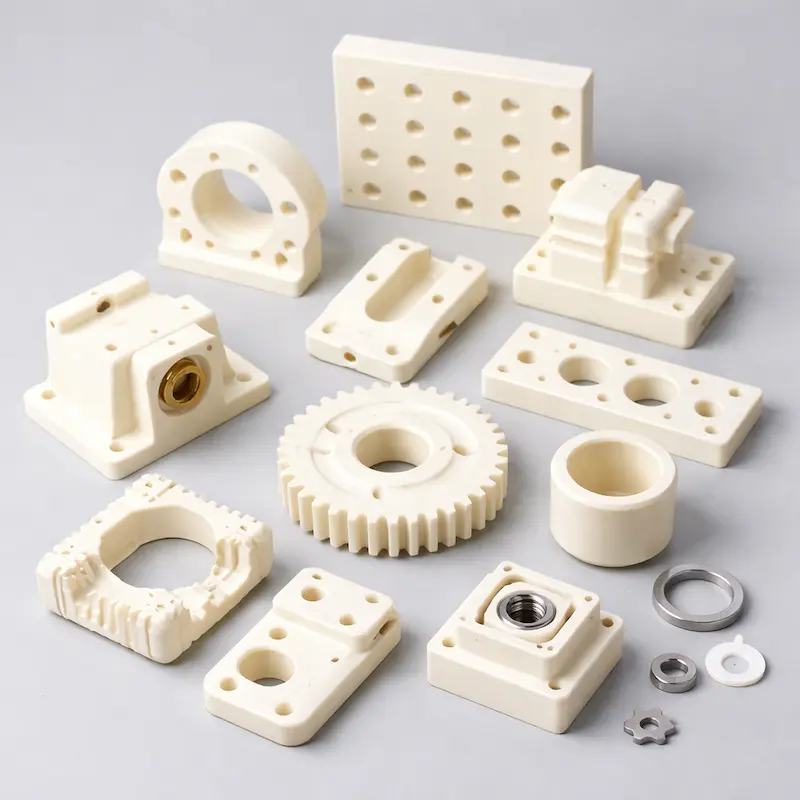
Engineering note: Values below are typical reference ranges. Final manufacturability, tolerances, material condition, surface finish, cost, and lead time depend on the drawing, geometry, quantity, and selected process.
Upload CAD files and mark critical features for an engineering review before production.
| Process | CNC Machining |
|---|---|
| Material | Nylon-PA66 (engineering plastic) |
| Machining tolerance | ±0.2 mm |
| Minimum wall thickness | 0.8mm |
| Service temperature | 120℃ |
| Tensile strength | 45-55MPa |
| Density | 1.02 g/cm³ |
| Typical applications | Structural parts, insulation parts, wear-resistant sliding parts, gaskets/isolation parts, small batch functional parts and end-use parts |
| Order advice | It is recommended to provide 2D markings and explain the datum for key dimensions; it is recommended to reinforce or thicken thin-walled/slender parts; for the appearance, please note the surface requirements and whether texture processing is allowed. |
| Finishing | Chamfering, grinding, bonding, screen printing, laser engraving, painting |
| Typical lead time | Relevant to size, quantity, structural complexity and finishing; clear delivery and expedited options will be given after uploading the file |
It is used to remove sharp edges and improve assembly safety and feel; it is also more friendly to assembly introduction and sliding contact surfaces.
Used to improve surface processing texture and edge touch; if the appearance requirements are higher, it is recommended to note the surface grade and allowable texture direction.
Suitable for assembly or combination of functional structures after separate processing; it is recommended to note the location of the bonding surface, strength target and whether a positioning structure is required.
Used for logos, scales and text patterns; it is recommended to provide vector files and mark the location, size and color requirements.
Suitable for serial numbers, QR codes, logos and shallow engraved textures; please note the laser engraving content, location and acceptable contrast.
Used for appearance uniformity and color/texture realization; it is recommended to explain matte/semi-matte/high-gloss and appearance surface definition, and it is better to provide reference pictures.
It can reduce weight while satisfying structural support, and is suitable for equipment structural parts, brackets, isolation parts and small batch engineering parts.
Suitable for wear-resistant scenarios such as sliders, guides, bushings, and friction contact structures (it is recommended to clarify the contact surface and lubrication conditions).
Suitable for electrical insulation and corrosion-sensitive environments; if there are medium/temperature/humidity working conditions, please indicate in the remarks to facilitate selection and confirmation.
Assembly-friendly and consistent appearance can be achieved through chamfering, grinding, painting, screen printing, laser engraving, etc.; suitable for delivery from prototypes to small batches.
Nylon 66 (PA66) is commonly used in engineering plastic structural and functional parts, typically including:
If you need higher rigidity or higher temperature resistance, please describe the working conditions in the remarks, and we will help evaluate a more matching material solution.
You can refer to the material library parameters on this page:
For key assembly dimensions/hole position coordination, it is recommended to provide 2D markings and indicate datum and tolerances. We will confirm manufacturability and suggest processing solutions based on your key requirements.
The commonly used scope of the material library is as follows (specifically based on the structure and working conditions):
Nylon 66 (PA66) is often used for structural and functional validation and small batch functional parts. If long-term high temperature, strong load or stressed threaded connections are involved, please note the working conditions so that a more reliable solution can be evaluated.
It is recommended to provide 3D + 2D markings to get a faster and more accurate quote:
If you only have 3D, you can also quote; but when it comes to assembly holes/fitting dimensions, 2D marking can significantly reduce the back-and-forth confirmation time.
The quote of nylon-PA66 (CNC machining) usually depends not only on the volume, but also on common influencing factors:
Suggested remarks: usage, quantity, lead time, key dimensions and appearance requirements, the quote will be closer to your real goal.
The finishing supported by Nylon 66 (PA66) is as follows:
If you need a logo/scale/serial number, both screen printing and laser engraving are available; please provide the content file and location and size description, and we will suggest a more appropriate process combination based on your appearance and lead time.
It can be processed, but thin-walled/slender structures rely more on clamping and processing path design:
After uploading the file, you can do a DFM review first, and we will give you more reliable processing and clamping suggestions.
Nylon 66 (PA66) can be used for thread and assembly verification, but if high load or Repeated disassembly and assembly, it is recommended to be more cautious:
Write down your assembly method and working conditions in the notes, and we will give you targeted DFM suggestions faster.
The machined surface of engineering plastics will have certain processing textures. For a better appearance, it is recommended that you write clearly in the order notes:
Providing reference images or surface effect targets (matte/glossy) will facilitate quick alignment of acceptance criteria.
In order to get a faster and more accurate quote, it is recommended that you provide/explain when uploading the file:
The process is usually: Upload drawings → Project evaluation and quote → Production and delivery after confirmation. We will provide DFM suggestions and optional post-treatment solutions simultaneously during the quote stage.