
Chamfering (removing sharp edges is safer)
Used to remove sharp edges and improve assembly feel and safety; it also helps reduce edge stress concentration and risk of edge collapse.
PA (nylon) is one of the most commonly used engineering plastics in injection molding.
Quote checklist: Upload your 3D model and, when available, a 2D drawing. Identify the required process, material, quantity, critical dimensions, finish, appearance standard, and target delivery date.
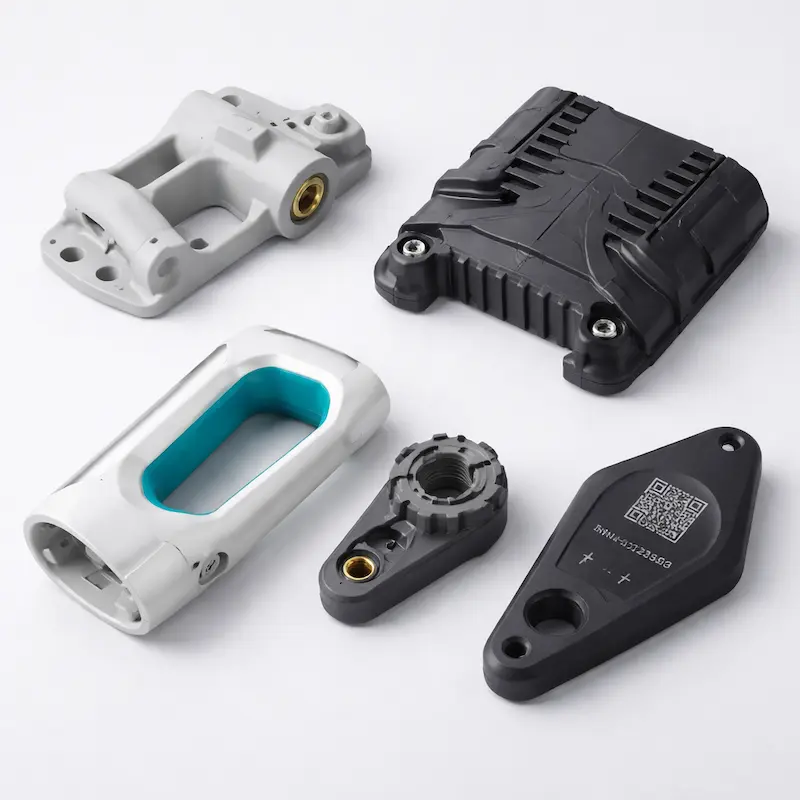
Engineering note: Values below are typical reference ranges. Final manufacturability, tolerances, material condition, surface finish, cost, and lead time depend on the drawing, geometry, quantity, and selected process.
Upload CAD files and mark critical features for an engineering review before production.
| Process | Injection Molding |
|---|---|
| Material | PA (nylon) |
| Accuracy | ±0.2 mm |
| Minimum wall thickness | 1.0mm |
| Service temperature | 300-600℃ |
| Tensile strength | 450-1100MPa |
| Density | 7.7-8.5 g/cm³ |
| Applications | Suitable for scenarios such as prototypes and functional validation, you can choose a more suitable material solution based on appearance, strength, temperature resistance and cost targets. |
| Finishing | Chamfering, grinding, bonding, screen printing, laser engraving |
| Typical lead time | It is related to the structural complexity, mold plan, quantity and finishing; clear lead time and expedited options will be given after uploading the file. |
Used to remove sharp edges and improve assembly feel and safety; it also helps reduce edge stress concentration and risk of edge collapse.
It can be used to remove gate marks, slight flash and surface defects; it is more helpful for appearance surfaces and assembly contact surfaces.
Suitable for large-scale separation, structural combination or local reinforcement; it is recommended to indicate the bonding location and strength/appearance requirements in the remarks.
Suitable for logos, scales and other graphic information; it is recommended to provide vector files and mark the location, size and direction.
Used for permanent identification, QR codes, serial numbers, etc.; when positioning and readability requirements are high, it is recommended to confirm the style and contrast first.
It is easy to strike a balance between cost and performance, and is suitable for the transition from prototype to small batch verification.
It is suitable for structural parts and functional validation parts that require weight control. Proper design can take into account both strength and rigidity.
By optimizing wall thickness, rib positions, gates and demoulding, the risks of shrinkage, warping and welding lines can be significantly reduced.
Supports chamfering, grinding, bonding, screen printing and laser engraving, making it easy to make logos and appearance finishing, and improve deliverability.
PA (injection molding) is suitable for prototype trial production, functional validation and small batch structural parts. The common demand is to balance cost and certain performance:
Quotations for injection molded PA are usually related to the following factors:
It is recommended to provide 3D + 2D annotations for faster and more accurate assessment:
If only 3D is provided, it is also recommended to indicate in the remarks: critical holes/critical surfaces, tolerance requirements, appearance surfaces and lead time.
The risk of deformation of injection molded PA usually comes from uneven wall thickness and improper control of shrinkage direction. It is recommended to:
It is recommended to reserve a draft angle for all side walls with a draft direction to reduce the risk of strain and ejection:
If you provide the appearance definition and surface requirements, we can give more specific suggestions before quoting.
Finishing supported by this material page includes:
The key to appearance control is to "define first and then implement it according to the mold and process." It is recommended that you write clearly in the remarks:
It is recommended to provide 2D annotations and clarify datums and tolerances, as well as:
It is recommended that you also specify when uploading the file:
In order to ensure clear identification and accurate location, it is recommended to provide: