
Polishing (improvement of appearance and contact surface)
Suitable for appearance surfaces and functional contact surfaces; it can reduce surface roughness, improve texture, and facilitate subsequent plating consistency.
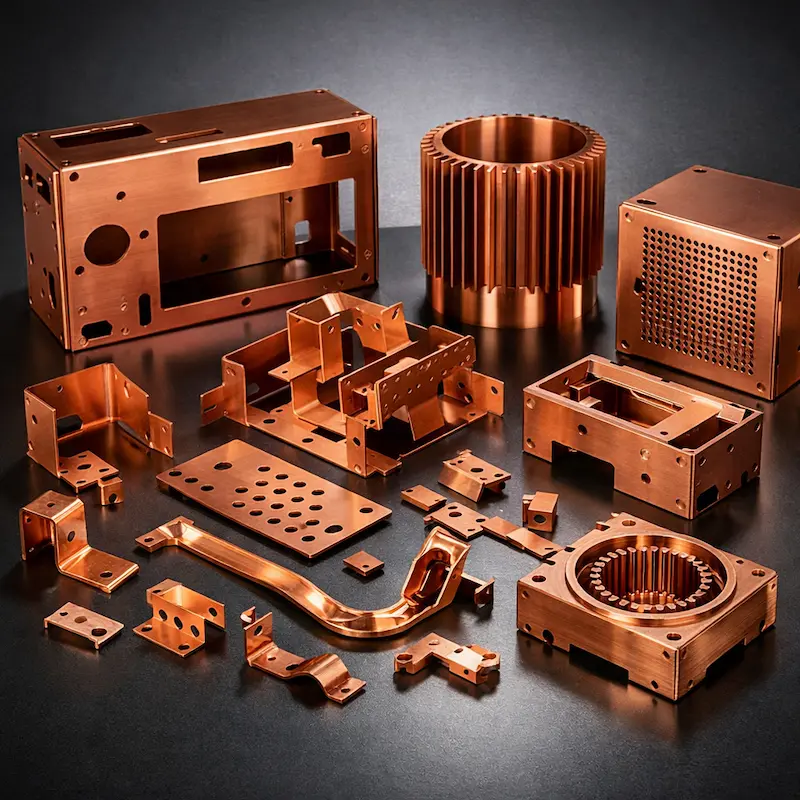
Copper (sheet metal fabrication) is documented with typical properties, suitable applications, finishing options, and design guidance for Sheet Metal Fabrication.
Quote checklist: Upload your 3D model and, when available, a 2D drawing. Identify the required process, material, quantity, critical dimensions, finish, appearance standard, and target delivery date.
Engineering note: Values below are typical reference ranges. Final manufacturability, tolerances, material condition, surface finish, cost, and lead time depend on the drawing, geometry, quantity, and selected process.
Upload CAD files and mark critical features for an engineering review before production.
| Process | Sheet metal fabrication (cutting/bending/punching/riveting, etc.) |
|---|---|
| Material | Red copper (high electrical conductivity/high thermal conductivity; easy to oxidize and discolor, it is recommended to choose an anti-oxidation or electroplating solution according to the use) |
| Accuracy | ±0.2 mm (General reference; it is recommended to provide 2D markings and tolerance requirements for key hole positions/fitting dimensions) |
| Recommended minimum thickness | 1.0mm (more conducive to bending stability and assembly strength; if it is thinner, please note the use and deformation tolerance) |
| Service temperature | 300–600℃ (reference range; related to working environment/connection method) |
| Tensile strength | 450–1100MPa (Platform reference range; different states vary greatly, please consult an engineer if you need to specify indicators) |
| Density | 7.7–8.5 g/cm³ |
| Bending recommendations | It is recommended that the inner bending radius R ≥ 1.0×plate thickness; if there are dense holes and grooves near the bending line, please give priority to DFM review |
| Hole Slot Recommendations | The distance from the hole to the bent edge is recommended to be ≥ 2.0×plate thickness; it is recommended to add rounded corners to long slots/narrow bridges to avoid stress concentration. |
| Burrs and edges | Deburring is performed by default; "chamfering/sharp removal standards" can be noted on the conductive contact surface to reduce assembly scratches and contact instability. |
| Finishing | Polishing, tin plating, nickel plating, anti-oxidation treatment, laser engraving |
| Typical lead time | Related to thickness, structural complexity, quantity and finishing; clear delivery and expedited options will be given after uploading the file |
Suitable for appearance surfaces and functional contact surfaces; it can reduce surface roughness, improve texture, and facilitate subsequent plating consistency.
Commonly used in conductive connections and welding scenarios; it can improve oxidation resistance and welding friendliness, and is suitable for connector/terminal structures.
Improves surface hardness and wear resistance, while improving oxidation resistance and appearance consistency; suitable for parts that require higher surface stability.
Copper is prone to oxidation and discoloration; if you are sensitive to appearance consistency/contact resistance, it is recommended to choose an anti-oxidation solution and clarify storage and packaging requirements.
Suitable for numbering, logo, batch traceability and installation direction marking; it is recommended to provide vector files and location and size instructions.
It is suitable for plate structural parts related to conductive connection, grounding, shielding and heat dissipation. It is a typical material selection for electrical sheet metal.
The process route of cutting + bending + punching/riveting is mature, which is convenient for quick prototyping and small batch repurchase.
The appearance and contact performance can be controlled through polishing, tin plating, nickel plating and anti-oxidation treatment to reduce the uncertainty caused by oxidation.
Supports laser engraving; more friendly to assembly direction, batch traceability and maintenance identification.
Copper (sheet metal fabrication) is often used for sheet parts related to conductive and electrical structures, such as:
If you are concerned about both appearance stability and contact performance, it is recommended to note whether anti-oxidation treatment, tin plating or nickel plating is required.
Copper easily forms an oxide film in an air and humidity environment, and its appearance will gradually darken or have color differences. Common control methods:
The conventional reference accuracy of red copper (sheet metal fabrication) is ±0.2;If you have key hole locations/assembly benchmarks, it is recommended:
In order to get a faster and more accurate quote, it is recommended that you provide the following when uploading the file:
Finishing supported by copper (sheet metal fabrication) includes: Polishing, tin plating, nickel plating, anti-oxidation treatment, laser engraving.
The oxide film on the copper surface may cause discoloration of the appearance and cause contact instability in some connection methods. Common suggestions for conductive parts:
Please indicate the connection method (bolt crimping/welding/spring contact, etc.) and contact surface requirements in the remarks, and we will provide a more matching solution.
Bending cracking and springback are related to plate thickness, material condition and bending radius. Common avoidance suggestions:
The quote of copper sheet metal is usually determined by the following factors:
Cost-saving ideas: Reduce unnecessary small holes/dense grooves, avoid ultra-narrow bridges and multiple bends; select the most necessary surface finishing after clear appearance/conductivity requirements.
We support mainstream 3D/2D project files:
Red copper (sheet metal fabrication) recommendations: 2D annotation + bend direction/angle(Attach an expanded view if necessary), and clearly indicate the purpose (conductivity/shielding/appearance) and surface treatment requirements in the remarks.
In order to get a faster and more accurate quote, it is recommended that you also indicate when uploading the file:
You only need three steps: Upload drawings → Confirm project evaluation and quote → Production and delivery after confirmation.