
Sandblasting (unified texture/deburring look and feel)
Used to achieve a more uniform matte finish with a clean appearance while improving surface consistency prior to painting/plating.
Carbon steel 45# is a commonly used medium carbon steel, characterized by "high strength, good heat treatment performance, and wide application."
Quote checklist: Upload your 3D model and, when available, a 2D drawing. Identify the required process, material, quantity, critical dimensions, finish, appearance standard, and target delivery date.
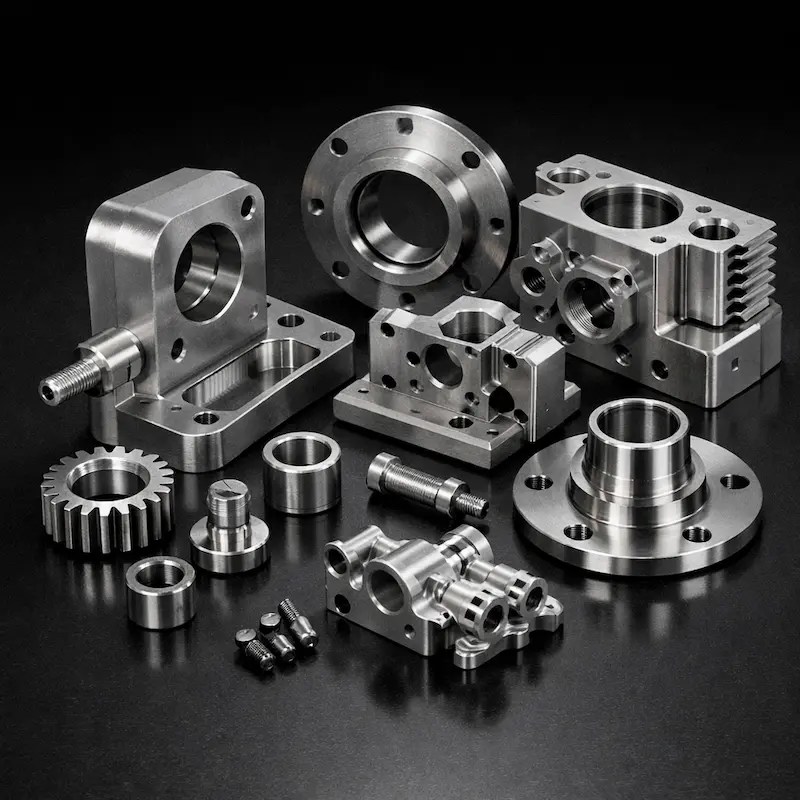
Engineering note: Values below are typical reference ranges. Final manufacturability, tolerances, material condition, surface finish, cost, and lead time depend on the drawing, geometry, quantity, and selected process.
Upload CAD files and mark critical features for an engineering review before production.
| Process | CNC precision machining (carbon steel/medium carbon steel) |
|---|---|
| Material | Carbon steel 45# (45 steel / 45 steel, medium carbon steel) |
| Machining tolerance (reference) | ±0.2 mm (common reference; for key coordination, please follow the drawing tolerances and benchmarks) |
| Minimum wall thickness (reference) | 1.0 mm (partially thin-walled/slender structures need to be evaluated based on size, tooling and clamping) |
| Temperature resistance (reference) | 300–600℃ (related to working conditions, surface condition and heat treatment requirements) |
| Tensile strength (reference) | 450–1100 MPa (depending on material condition/heat treatment requirements; please refer to drawings or requirements) |
| Density (reference) | 7.7–8.5 g/cm³ |
| Surface roughness (reference) | It is related to the tool, tool path and process route; if you need Ra index, please mark and explain the appearance surface in the drawing. |
| Rust Prevention Recommendation | 45# is easy to rust. It is recommended to choose blackening/oxidation/galvanizing/powder coating/painting based on the environment. |
| Finishing | Sand blasting, blackening, oxidation, galvanizing, nickel plating, powder coating, painting |
| Typical lead time | Relevant to size, quantity, processing difficulty and surface finishing; clear delivery and expedited options will be given after uploading the file |
Used to achieve a more uniform matte finish with a clean appearance while improving surface consistency prior to painting/plating.
Suitable for structural parts that require appearance and light rust resistance; if the environment is humid or used outdoors, it is recommended to use a stronger protection solution.
It is used to improve surface stability and certain protective capabilities; the specific effect is related to the process route, part geometry and pre-treatment.
Suitable for parts in humid environments or requiring stronger rust resistance; if there are matching dimensions, please pay attention to the impact of coating thickness.
It can improve the appearance and corrosion resistance; for size-sensitive areas, it is recommended to communicate the coating requirements and masking plan in advance.
Suitable for parts that have higher requirements for wear resistance, scratch resistance and appearance consistency; the corners/hole locations need to be evaluated in combination with the structure to evaluate the masking and thickness.
Color, gloss (matte/high gloss) and appearance standard control can be achieved; it is recommended to provide reference pictures or clarify the appearance.
Suitable for structural parts, fixtures and industrial parts, taking into account load-load-bearing capacity and cost control.
When you need higher strength/wear resistance, heat treatment and finishing routes can be used as required to achieve performance goals.
It has strong adaptability to common processes such as turning, milling, drilling, and tapping, and is suitable for low- to medium-volume production and repeated parts delivery.
Supports sandblasting, blackening, galvanizing, powder coating, painting and other solutions to facilitate matching of different usage environments and appearance standards.
45# Carbon Steel is often used in structural parts such as fixtures, supports, and transmission structures. Its advantages are concentrated in:
Carbon steel 45# belongs to the carbon steel system, and its corrosion resistance is not as good as stainless steel. A common risk is that it is more susceptible to corrosion in humid/outdoor/salt spray environments.
It is recommended to refer to the markings on the drawings, especially the assembly holes, positioning surfaces and matching dimensions:
For faster and more accurate quote, it is recommended to provide:
If it is only 3D, it is also recommended to write down the key fitting dimensions, tolerance requirements and surface finishing targets in the remarks.
The machining quote is not only related to the volume, but is usually affected by the following factors:
Optional finishing for carbon steel 45# (CNC machining) includes:
If you are not sure which one to choose, it is recommended to note the usage environment (indoor/moist/outdoor/oil stain) and appearance standards, and we will give a more prudent processing route based on risk priority.
Can. It is recommended that you make it clear in the drawings or notes:
Heat treatment can be evaluated on demand, but heat treatment often brings certain risks of dimensional changes or deformation:
The following structures are more likely to bring processing risks or cost increases:
It is recommended that you also indicate when uploading drawings:
After uploading the file, we will feedback the quote and manufacturability suggestion (DFM) as soon as possible, and give you a process route suggestion based on your tolerance and rust prevention goals.