
polish
Used to improve surface finish and metallic texture. If there are requirements for mirror effect or "visible texture", please define the appearance surface and standards.
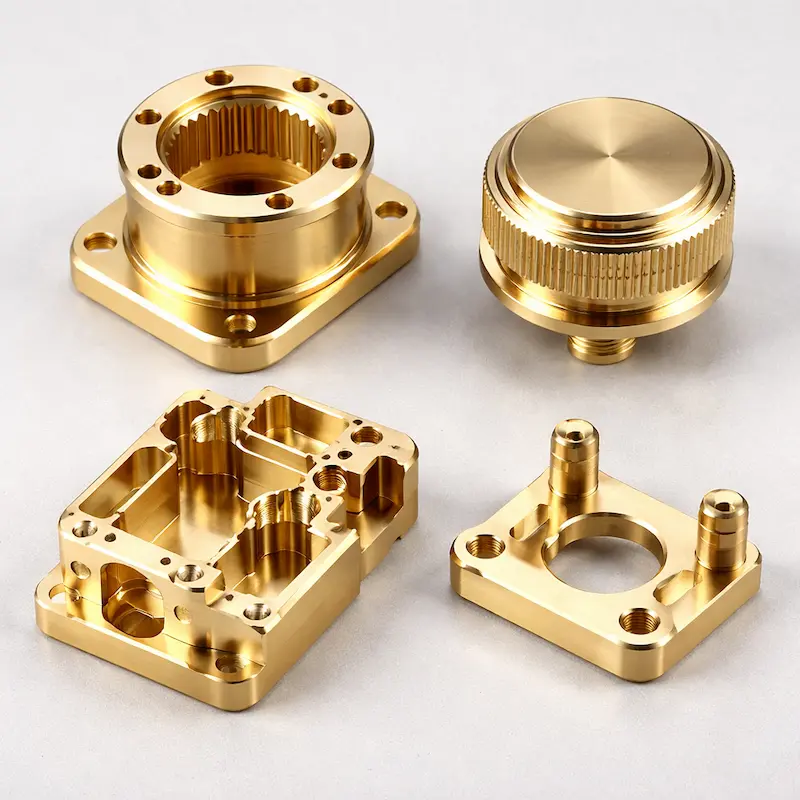
Brass H62 is a widely used general-purpose Brass, with advantages such as "balanced strength and plasticity, good machinability, and easy appearance to handle," making it suitable for turning/milling for general-purpose parts and decorative appearances.
Quote checklist: Upload your 3D model and, when available, a 2D drawing. Identify the required process, material, quantity, critical dimensions, finish, appearance standard, and target delivery date.
Engineering note: Values below are typical reference ranges. Final manufacturability, tolerances, material condition, surface finish, cost, and lead time depend on the drawing, geometry, quantity, and selected process.
Upload CAD files and mark critical features for an engineering review before production.
| Process | CNC machining (brass-H62/copper alloy) |
|---|---|
| Material type | Metal | Copper alloy |
| Accuracy | ±0.2 mm |
| Minimum wall thickness | 1.0mm |
| Service temperature | 300-600℃ |
| Tensile strength | 450-1100MPa |
| Density | 7.7-8.5 g/cm³ |
| Structural suggestions | Please provide complete 2D annotation for deep hole/thin groove/thin-wall structure; if assembly is required, it is recommended to clarify the hole tolerance and datum plane. |
| Appearance suggestions | If selected polish or Electroplating (nickel/chromium/gold), it is recommended to mark the appearance surface and allowable grain direction; please indicate the areas that need to be shielded (such as assembly surface/conductive surface/mating surface) in the remarks. |
| Finishing | Polishing, electroplating (nickel/chromium/gold), sandblasting, laser engraving |
| Typical lead time | Related to structure, quantity, precision and finishing; clear delivery and expedited options will be given after uploading the file |
Used to improve surface finish and metallic texture. If there are requirements for mirror effect or "visible texture", please define the appearance surface and standards.
Used for appearance decoration, corrosion resistance and surface properties improvement. Please indicate coating type and appearance goals (color/brightness/shaded area).
Used to achieve a uniform matte texture and weaken lightly processed lines. When plating/repolishing after sandblasting, please indicate the process sequence in the remarks.
Suitable for model, logo, QR code and logo engraving. It is recommended to provide vector files/clear artwork and indicate the location, size and depth requirements.
Taking into account processing feasibility and appearance performance, it is suitable for end-use parts and small batch delivery.
Supports polishing, electroplating (nickel/chromium/gold), sandblasting and laser engraving, making it easy to combine processes according to appearance goals.
The transition from prototypes to small batches can be smooth; critical dimensions can be risk-controlled through 2D annotation and DFM review.
Through constraints such as appearance surface/masking surface/grain direction, the goal of "looking like a finished product" is reduced to executable processing and quality inspection requirements.
Brass H62 is suitable for processing structural parts, cosmetic parts and small batch parts.
If you need to enhance the finished product through surface effects, you can indicate in the order notes whether polishing, electroplating (nickel/chrome/gold), sandblasting or laser engraving is required.
It is recommended to give priority to the drawing markings; at the same time, you can refer to the key parameters (accuracy, minimum wall thickness, etc.) on this page.
In order to get a faster and more accurate quote, it is recommended to note: usage, quantity, lead time, appearance standard, whether polishing/electroplating/sandblasting/radium engraving is required, as well as key dimensions and tolerance requirements.
Brass H62 supports: polishing, electroplating (nickel/chromium/gold), sandblasting, laser engraving.
Finishing will affect lead time and appearance standards. Please clarify the process combination and appearance requirements (such as plating type, polishing level, sandblasting texture, laser engraving content) when enquiring.
It is recommended to define the appearance surface and acceptable grain standards; if you need a closer mirror effect, you can provide a reference picture or explain the "visible grain/knife mark" acceptance range.
Please specify in the remarks: plating type (nickel/chromium/gold), appearance target (color/brightness), whether a masked area is required, and whether thickening of the plating is allowed on the mating surface.
Sandblasting is often used to achieve a more uniform matte texture and soften lightly machined lines.
If electroplating or polishing is required later, please indicate the process sequence and target appearance in the remarks, and we will give suggestions based on manufacturability assessment.
Laser engraving is suitable for models, logos, QR codes and traceability information. It is recommended to provide vector files (or clear artwork) with location, size and depth requirements marked.
It is recommended to provide 3D + 2D markings for faster and more accurate quote:
Thin walls, deep holes, fine grooves and long cantilever structures are more dependent on tooling and tooling strategies, and the risk of deformation/tool vibration is higher.
It is recommended to reserve processing space during the design stage, avoid extreme thickness changes, and apply for DFM review when placing an order to confirm manufacturability in advance.
Clearly writing "purpose + quantity + lead time + appearance/finishing requirements + critical dimensional tolerances" can significantly improve the efficiency and accuracy of quote.
Three-step process: Upload documents → Project evaluation and quote → Production delivery after confirmation.