
sandblasting
Used to obtain a more uniform matte appearance and more consistent surface texture; suitable for surface preparation before cosmetic parts and spray coating/oxidation.
Aluminum alloy 7075 (Al-Zn-Mg-Cu series) is a representative high-strength aluminum alloy, with advantages such as "very high strength/hardness and excellent lightweight effect," making it suitable for high-load-bearing structural parts and parts requiring high rigidity.
Quote checklist: Upload your 3D model and, when available, a 2D drawing. Identify the required process, material, quantity, critical dimensions, finish, appearance standard, and target delivery date.
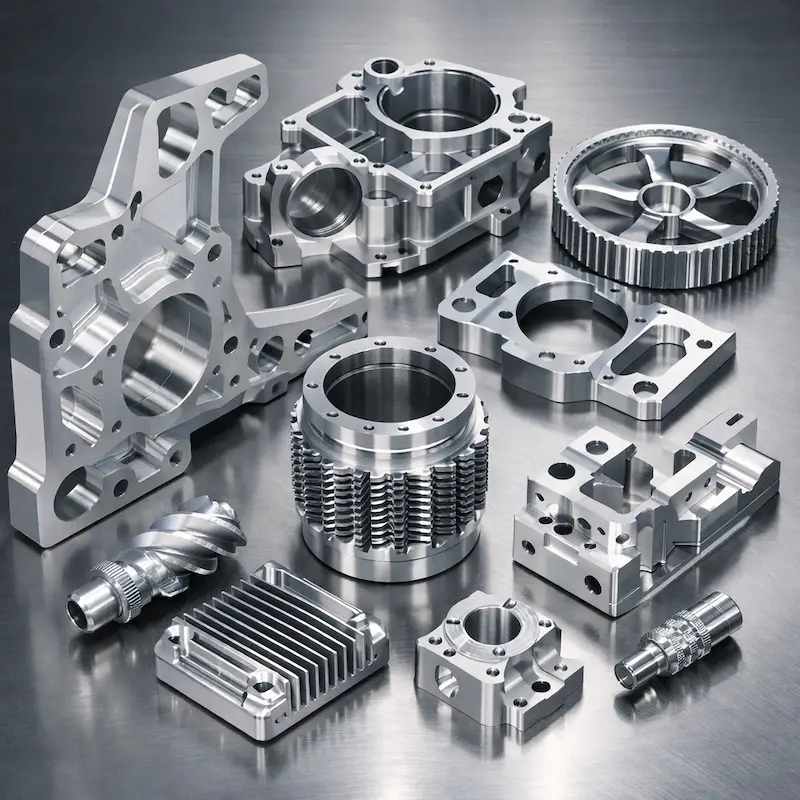
Engineering note: Values below are typical reference ranges. Final manufacturability, tolerances, material condition, surface finish, cost, and lead time depend on the drawing, geometry, quantity, and selected process.
Upload CAD files and mark critical features for an engineering review before production.
| Process | CNC precision machining (aluminum alloy 7075) |
|---|---|
| Material | Aluminum alloy 7075 (higher strength, more suitable for high-strength structural parts) |
| Machining tolerance | ±0.2 mm (based on the key dimension requirements of the drawings/remarks; it is recommended to clarify the datum and tolerance zone) |
| Minimum wall thickness | ≥1.0 mm (thin-walled/long cantilever structures are recommended to undergo DFM review first) |
| Service temperature | 200℃ |
| Tensile strength | 320–460 MPa |
| Density | 2.65 g/cm³ |
| Surface treatment | Sand blasting, anodizing, powder coating, painting, screen printing, laser engraving, polishing, wire drawing |
| Typical lead time | Relevant to structural complexity, quantity, clamping difficulty and surface finishing; clear delivery and expedited options will be given after uploading the file |
Used to obtain a more uniform matte appearance and more consistent surface texture; suitable for surface preparation before cosmetic parts and spray coating/oxidation.
Used to improve surface protection and appearance consistency; if there are mating surfaces/conductive surfaces/ground planes that need to be shielded, please specify them in the drawings or notes.
Suitable for surface solutions that require stronger coverage and wear-resistant protection; it is recommended to note color, texture and masking requirements.
Suitable for appearance color and texture requirements (matte/high gloss, etc.); it is recommended to provide reference pictures or clarify appearance standards.
Suitable for logos, scales and other graphic information; it is recommended to provide vector files and location and size instructions.
Used for permanent identification, serial numbers, QR codes, etc.; if higher contrast is required, it can be evaluated together with surface finishing solutions.
Used to improve local or overall smoothness and texture; please mark the polishing range and appearance priority.
Used to obtain a more consistent grain direction and metallic texture; please mark the drawing direction and appearance surface in the drawing.
In the aluminum alloy system, it is more "high-strength" oriented and is suitable for parts that are more sensitive to strength, such as brackets, clamps, and load-bearing structural parts.
It is suitable for continuous iteration from prototypes to small batches; when the drawings are clear and the benchmarks are clear, it is more conducive to rapid quote and stable delivery.
Supports various surface paths such as sandblasting, anodizing, powder coating, painting, wire drawing, and polishing to facilitate the balance between "appearance texture/protection/cost/lead time".
Marking can be completed through screen printing/laser engraving; key hole positions, mating surfaces and assembly benchmarks can be confirmed in advance during the DFM stage to reduce the risk of rework.
7075 Aluminum Alloy is more suitable for parts that are more sensitive to strength and want to remain lightweight, including brackets, clamps, structural parts and connectors. The core advantages are usually reflected in:
The key factors that affect the quote and lead time of aluminum alloy 7075 (CNC machining) usually include:
Common concerns for aluminum alloy 7075 (CNC machining) include processing accuracy, minimum wall thickness, temperature resistance, tensile strength and density, etc. For key parameter criterias on this page, please refer to:
If you have assembly fit or appearance standards, it is recommended to specify the "critical holes/critical surfaces/appearance surfaces" in the 2D drawings or notes. The evaluation will be faster and more accurate.
We support mainstream 3D/2D project files:
Common practices for faster and more accurate delivery: priority delivery STEP + 2D annotation, and describe the key tolerances, appearance surface and surface treatment requirements in the remarks.
7075 Aluminum Alloy supports finishing including: sandblasting, anodizing, powder coating, painting, screen printing, laser engraving, polishing, and wire drawing.
In order to avoid rework and misunderstanding, it is recommended that you write clearly in the remarks:
It is recommended to specify in 2D drawings or notes:
This allows for faster alignment of appearance criteria and cost expectations during the quote stage.
This type of structure is more likely to cause vibration, deformation or tool inaccessibility problems. It is recommended that:
It is recommended that you also provide STEP + 2D annotation and make it clear:
When your parts have more "strength-first" structural requirements (such as brackets, clamps, load-bearing connectors), and you want to increase structural strength while maintaining lightweight, aluminum alloy 7075 (CNC machining) is usually more suitable.
If your needs are more corrosion resistance or formability, or have specific constraints on the material system, it is recommended to describe the use environment and goals in the remarks, and we will synchronize the manufacturability and surface finishing strategies during the evaluation phase.
In order to get a faster and more accurate quote, it is recommended that you provide/explain when uploading the file:
You only need three steps: Upload drawings → Confirm project evaluation and quote → Production and delivery after confirmation.